

By DAYO ADESULU
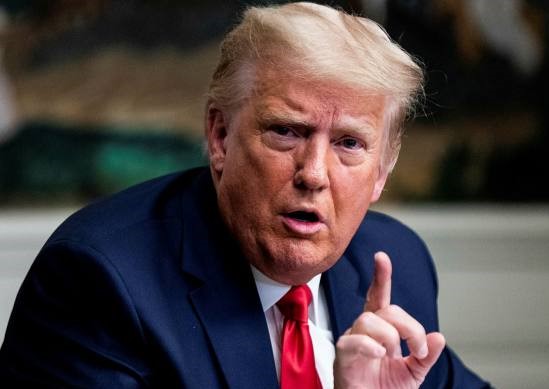
Tension has sharply escalated in Nigeria–United States relations after former U.S. President Donald Trump issued a dramatic threat of possible military action against Nigeria, following President Bola Ahmed Tinubu’s firm rejection of claims that the country allows the killing of Christians.
The warning, which has sparked widespread concern across diplomatic, security, and religious circles, came amid Trump’s renewed allegations that Nigeria has become religiously intolerant and unsafe for Christians.
Trump Orders Pentagon to Prepare for Possible Action
Trump, speaking on Saturday, November 1, disclosed that he had instructed the United States Department of Defence to prepare for a potential military operation in Nigeria if the government “continues to allow the killing of Christians.”
According to him, Washington would also immediately suspend all forms of aid and assistance to Nigeria, a move that could have far-reaching implications for security cooperation and humanitarian programmes in the country.
Citing reports attributed to Reuters, Trump went further, stating that the U.S. could “very well go into that now disgraced country, guns-a-blazing,” with the objective of wiping out what he described as Islamic terrorists responsible for atrocities against Christians.
The statement marked one of the most aggressive foreign policy comments Trump has made concerning Africa, instantly triggering diplomatic ripples.
Nigeria Named Among ‘Countries of Particular Concern’
Trump’s threat followed his earlier decision to label Nigeria as one of the “countries of particular concern” (CPC) under the U.S. International Religious Freedom Act (IRFA).
Under U.S. law, CPC designation applies to countries accused of engaging in or tolerating systemic and severe violations of religious freedom. Trump alleged that Christians in Nigeria face an “existential threat,” claiming that thousands had been killed by “radical Islamists.”
The claim reignited a long-running international debate over whether Nigeria’s security crisis should be framed primarily as religious persecution or as a complex insurgency and criminality problem affecting all communities.
Tinubu Pushes Back, Defends Nigeria’s Constitution
President Bola Tinubu responded swiftly and personally to Trump’s allegations.
In a public statement issued on Saturday, Tinubu insisted that Nigeria remains a democratic nation governed strictly by its constitution, which guarantees freedom of religion for all citizens.
“Nigeria stands firmly as a democracy governed by constitutional guarantees of religious liberty,” the president stated.
He stressed that the Nigerian government does not promote or tolerate religious persecution and reaffirmed his administration’s commitment to engaging leaders across religious divides to foster unity.
Tinubu also emphasized that Nigeria’s security challenges affect Muslims, Christians, and traditional worshippers alike, noting that terrorism, banditry, and kidnapping are criminal threats rather than state-sanctioned religious campaigns.
‘Nigeria’s Diversity Is Our Strength’ – Tinubu
Rejecting Trump’s characterisation outright, Tinubu described Nigeria’s religious and ethnic diversity as a symbol of national unity rather than division.
He noted that for over a decade, Nigeria has battled terrorism, beginning with Boko Haram in the northeast, before the violence expanded into banditry and kidnapping across other regions.
According to the president, these security challenges require collaboration and understanding, not sweeping labels that risk inflaming tensions.
Foreign Ministry Calls Trump’s Claims ‘Inaccurate’
Nigeria’s Ministry of Foreign Affairs also weighed in, describing Trump’s assertion of mass Christian killings as inconsistent with the realities on the ground.
Government officials argued that while Nigeria faces undeniable security issues, the violence is not targeted exclusively at Christians, nor is it driven by state-backed religious intolerance.
The ministry warned that framing Nigeria’s crisis purely in religious terms could undermine international cooperation and oversimplify a deeply complex security situation.
International Reactions and Rising Anxiety
Trump’s comments have drawn global attention, with observers warning that such rhetoric could destabilize diplomatic relations and worsen internal tensions within Nigeria.
Analysts say the threat of military intervention—however unlikely—adds pressure to an already fragile security environment, while raising questions about how international powers interpret Nigeria’s internal conflicts.
Despite the heated language, several commentators maintain that direct U.S. military action in Nigeria remains improbable, citing sovereignty concerns, regional stability, and existing diplomatic frameworks.
What This Means for Nigeria–US Relations
The episode marks a critical moment in Nigeria–US relations, highlighting the growing international scrutiny of Nigeria’s security challenges.
While Tinubu’s government continues to push a narrative of constitutional order and religious coexistence, Trump’s remarks underscore how global political rhetoric can quickly escalate into diplomatic flashpoints.
For now, Nigeria stands firm in rejecting the accusations, even as tensions linger and the world watches closely.
Key Takeaway
As Trump threatens military action in Nigeria, the Tinubu administration has chosen defiance over silence, insisting that Nigeria’s crisis is one of security, not religion—and that its sovereignty is non-negotiable.
#Trump #BolaTinubu #NigeriaUSRelations #ReligiousFreedom #NigeriaSecurity #BreakingNews #Geopolitics
