

By DAYO ADESULU
The Rector of , Dr. Engr. Ibraheem Adedotun Abdul, has stressed that interfaith harmony for national unity remains essential to Nigeria’s peace, institutional growth, and long-term development.
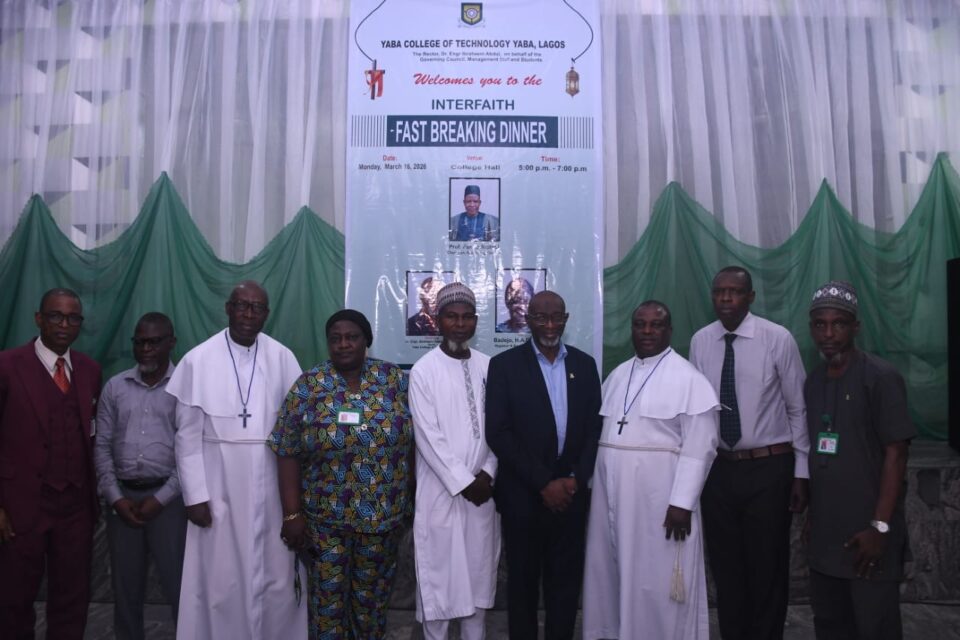
He made this assertion during an interfaith fast-breaking dinner hosted by the institution, where Christians observing Lent and Muslims observing Ramadan gathered in a rare show of unity. The event brought together staff, students, and religious leaders to reflect on shared values across faiths.
YABATECH Promotes Unity Through Religious Inclusion
Dr. Abdul described the initiative as a deliberate effort by YABATECH to deepen peaceful coexistence within its diverse academic community. According to him, interfaith harmony for national unity should not be treated as an abstract idea but as a practical framework for building stronger institutions.
He noted that the college views religious diversity as a strategic advantage rather than a source of division.
“Our diversity is not a challenge but a strength. The difference in our faiths is not a wall meant to separate us but a bridge for understanding and mutual coexistence,” he said.
Furthermore, he explained that the convergence of Ramadan and Lent offers a powerful moment for reflection, urging both Christians and Muslims to embrace shared values such as sacrifice, compassion, discipline, and devotion to God.
Ramadan and Lent: A Shared Spiritual Opportunity
The Rector highlighted that the overlapping seasons provide a unique platform to reinforce interfaith harmony for national unity. He encouraged participants to translate the spiritual lessons of fasting into everyday conduct, both within and beyond the campus.
According to him, fasting goes beyond religious rituals. Instead, it builds character and strengthens human relationships.
He pointed out that values such as patience, charity, and self-restraint should inspire greater dedication to duty, improved interpersonal relationships, and collective responsibility.
“If we want peace in the larger society, it must begin within our immediate communities. Our campus must continue to exemplify the values of unity, tolerance and cooperation,” Abdul added.
Religious Leaders Emphasise Dialogue and Mutual Respect
Speaking on the theme Interfaith Harmony and National Unity, the college Chaplain, , reinforced the importance of continuous dialogue among different religious groups.
He explained that interfaith harmony for national unity plays a critical role in building trust, reducing tensions, and strengthening community bonds.
“Interfaith harmony is essential for social stability. It promotes trust, reduces conflict and strengthens the foundations of national development,” he said.
Rev. Awe also noted that Nigeria’s unity depends on the willingness of citizens to look beyond religious and cultural differences in pursuit of shared goals.
Education as a Platform for Unity
Similarly, , who represented the Muslim community, described educational institutions as natural environments for promoting tolerance and collaboration.
He argued that schools must lead the way in fostering understanding across religious divides, adding that peace and coexistence remain universal values shared by all faith traditions.
His remarks further reinforced the idea that interfaith harmony for national unity can be achieved when institutions consciously promote inclusiveness and respect.
Fasting as a Pathway to Spiritual Renewal and Peace
Adding a broader spiritual perspective, spoke on Fasting as a Pathway to Spiritual Renewal, Discipline and Peaceful Coexistence.
He explained that fasting is a shared spiritual discipline across major religions, including Christianity, Islam, Judaism, Hinduism, and Buddhism.
According to him, while rituals may differ, the underlying purpose remains the same—turning away from material distractions to focus on God, cultivate empathy, and strengthen the human spirit.
Rev. Kuyebi described fasting as more than abstaining from food, calling it a spiritual detox that enhances consciousness and moral discipline.
He noted that in Islam, Ramadan fosters Taqwa—a deep awareness of God—while in Christianity, Lent encourages reflection and renewed commitment, inspired by the 40-day fast of .
He also referenced the Jewish observance of Yom Kippur as a period dedicated to atonement and introspection, stressing that these shared practices highlight the universal relevance of interfaith harmony for national unity.
Strengthening National Unity Through Shared Values
The event concluded with a joint breaking of fast by both Muslim and Christian participants, symbolising unity in diversity and reinforcing the institution’s commitment to peaceful coexistence.
Observers noted that such initiatives go beyond symbolic gestures. Instead, they provide practical models for how Nigeria can address religious tensions and build a more cohesive society.
As conversations around national unity continue to dominate public discourse, stakeholders believe that interfaith harmony for national unity must remain at the centre of policy, education, and community engagement.
YABATECH’s approach, they argue, offers a replicable template for other institutions across the country.
In a nation often divided along religious lines, the message from the institution remains clear: unity begins with understanding, and understanding begins with dialogue.
#Hashtags
#InterfaithHarmony #NationalUnity #YABATECH #ReligiousTolerance #Ramadan #Lent #NigeriaNews #Peacebuilding #EducationForUnity
