

By DAYO ADESULU
ABUJA — For millions of Nigerian children, the journey through school ends long before they ever step into a senior secondary classroom. Behind every statistic is a child whose dream of becoming a doctor, teacher, engineer or entrepreneur has been interrupted by poverty, distance, insecurity or the absence of a nearby school.
Now, the Federal Government says it is ready to tackle one of the structural problems it believes has contributed to that reality.
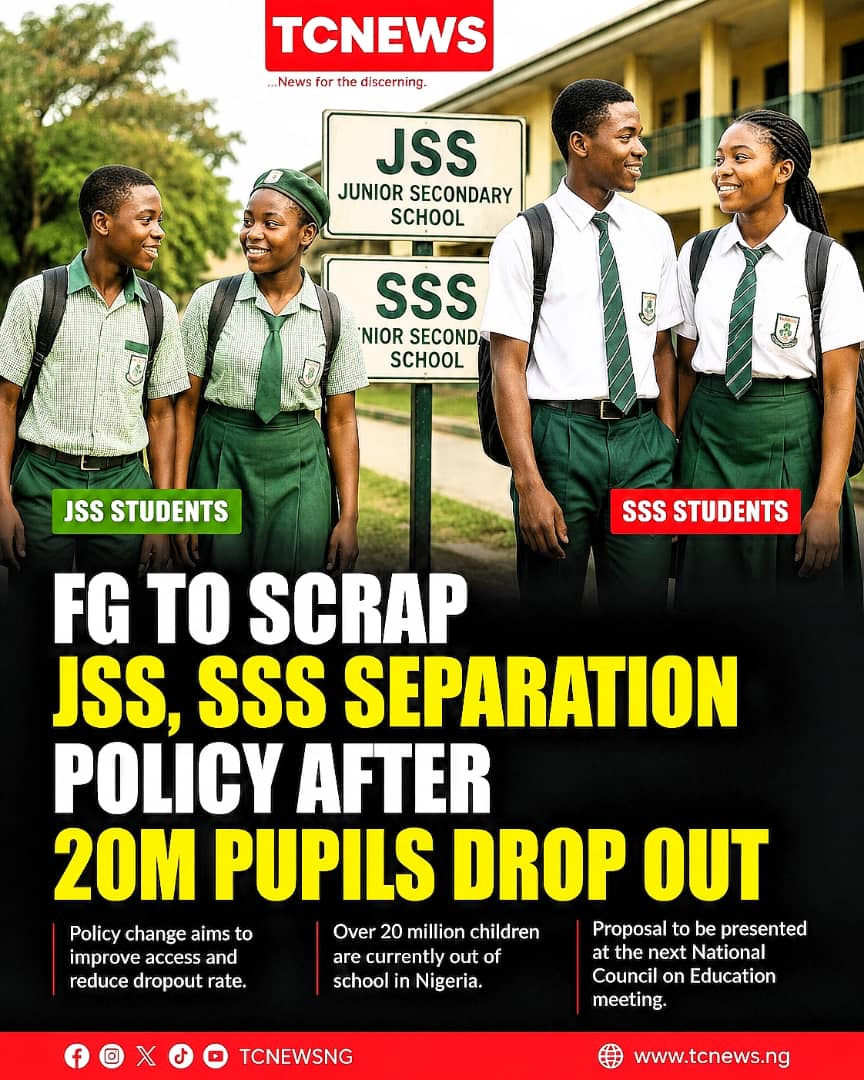
The Minister of Education, Dr. Tunji Alausa, announced that the government plans to discontinue the long-standing policy that separates Junior Secondary Schools from Senior Secondary Schools, arguing that the arrangement has failed to improve access to education and has instead created new barriers for millions of learners.
The announcement comes against the backdrop of alarming figures showing that more than 20 million Nigerian children are currently out of school, one of the highest numbers anywhere in the world.
A School Journey That Ends Too Soon
Across many communities, completing primary education does not automatically lead to enrollment in junior secondary school. Even for those who make the transition, many never continue to senior secondary education.
Education stakeholders say several factors—including poverty, insecurity, early marriage, child labour and inadequate school infrastructure—continue to force children out of classrooms.
Government officials now believe the separation of junior and senior secondary schools has also played a role by creating additional obstacles for students who should ordinarily continue their education without disruption.
Government Says Policy Has Failed
According to the Minister of Education, the existing arrangement has produced an imbalance in Nigeria’s education system.
While public primary schools are widely distributed across the country, junior secondary schools are far fewer, creating overcrowding in some locations while leaving facilities elsewhere underutilised.
The proposed policy change seeks to allow a smoother transition from basic education to senior secondary education by reducing administrative and infrastructural barriers.
The proposal will be presented before the National Council on Education for consideration before implementation.
Millions of Dreams at Stake
Beyond statistics, the decision carries enormous significance for families struggling to keep their children in school.
In many rural communities, parents already face transportation costs, school fees, uniforms and learning materials. Having to move children to another distant school after junior secondary education often becomes the point at which many students abandon their education entirely.
Education advocates argue that making the transition easier could improve retention and eventually increase the number of students completing secondary education.
Smart Schools Also Under Review
The Federal Government also announced fresh efforts to ensure that numerous government-funded Smart Schools, Alternative Schools and Bilingual Schools across Nigeria begin operating as originally intended.
A monitoring committee has been inaugurated to oversee the completion, handover and commencement of learning activities in these facilities.
Officials expressed concern that several completed projects have remained unused despite significant public investment.
Experts Want Action Beyond Policy
Education analysts say changing the structure alone will not solve Nigeria’s education crisis.
They insist that lasting progress will depend on recruiting more qualified teachers, improving security around schools, expanding classroom infrastructure and ensuring that children from poor families receive adequate support to remain in school.
They also stress the importance of making completed educational facilities functional rather than allowing them to remain abandoned.
Hope for Nigeria’s Next Generation
For countless Nigerian children, staying in school represents more than earning certificates—it offers a pathway out of poverty and an opportunity to build a better future.
Whether the proposed reform succeeds will depend not only on policy approval but also on effective implementation across the country’s states.
If properly executed, the changes could help reduce the number of children leaving school prematurely and provide millions with another chance to complete their education.
Hashtags: #Education #Nigeria #SchoolReform #OutOfSchoolChildren #FG #TunjiAlausa #EducationPolicy #TCNews
