

By DAYO ADESULU
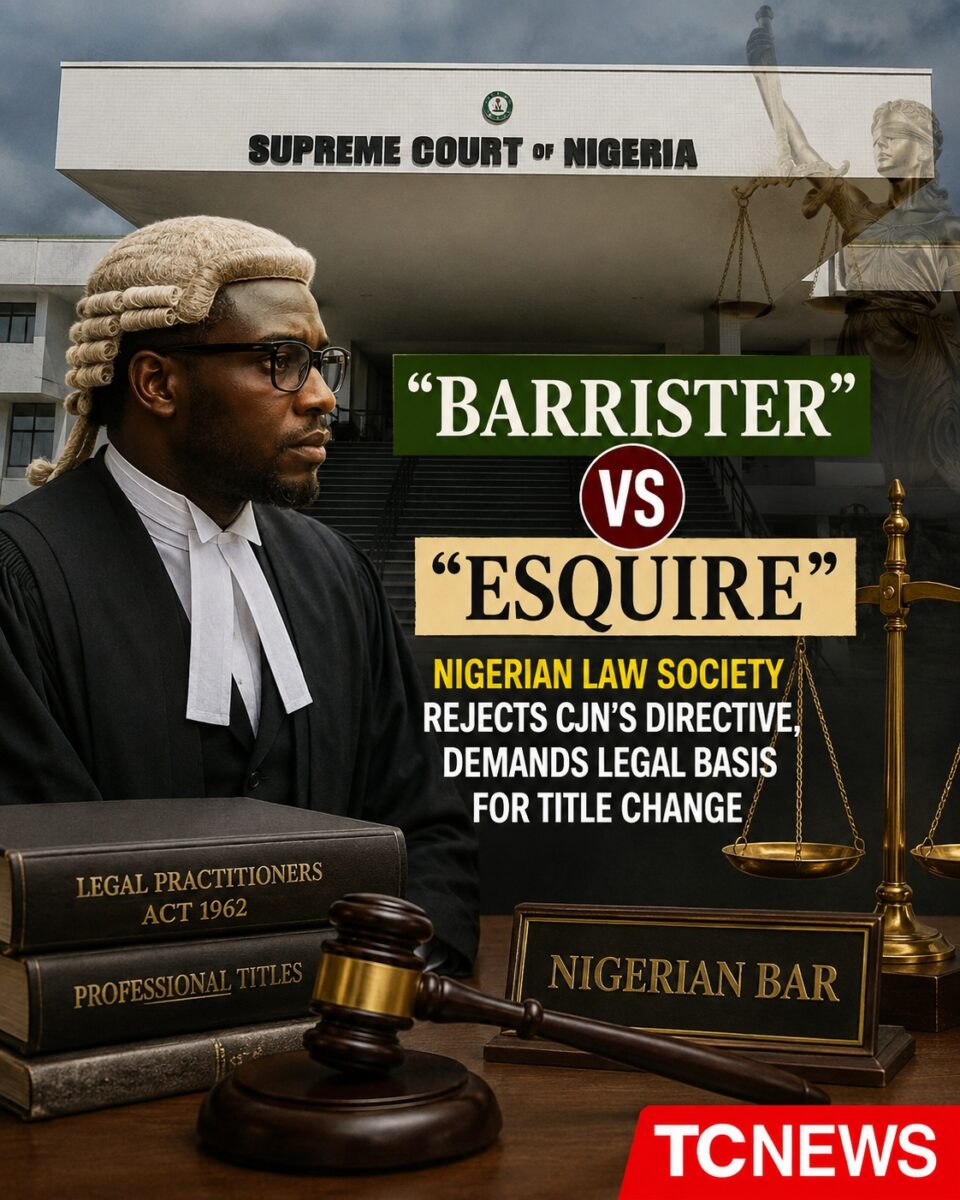
The Nigerian Law Society (NLS) has challenged a directive attributed to the Chief Justice of Nigeria (CJN), Justice Kudirat Kekere-Ekun, restricting lawyers from using the title “Barrister” before their names in official engagements at the Supreme Court.
The society questioned the legal authority behind the directive, arguing that there is no clear statutory provision empowering the Chief Justice of Nigeria to prohibit legal practitioners from using a professional designation recognised within Nigeria’s legal tradition.
The dispute has opened a fresh debate over professional titles, statutory authority and the limits of administrative powers within the Nigerian legal profession.
How the Supreme Court Directive Started
The controversy followed a memorandum dated July 13, 2026, issued by the Chief Registrar of the Supreme Court, Kabir Akanbi.
In the memo, lawyers, court registrars and other legal practitioners were reportedly directed to discontinue the use of “Barrister” and adopt “Esquire” as their professional designation in official engagements at the apex court.
The measure was said to be part of efforts to promote professional standards and uniformity in the administration of proceedings at the Supreme Court.
However, the Nigerian Law Society has rejected the reasoning behind the directive, insisting that professional designations must be anchored in law rather than administrative preference.
NLS: ‘Barrister’ Has Legal Recognition
In a statement issued on Wednesday, the NLS Executive Director, Dr Tonye Jaja, argued that the Legal Practitioners Act of 1962 recognises “Barrister” and “Solicitor of the Supreme Court of Nigeria” as professional descriptions associated with lawyers called to the Nigerian Bar.
Jaja acknowledged that simply describing oneself as “Barrister” might not constitute the complete formal professional designation in every context.
However, he questioned the legal basis for directing lawyers to abandon the term altogether and replace it with “Esquire”.
According to the NLS, neither “Esquire” nor the abbreviation “Esq.” is expressly provided for as a professional title under the Legal Practitioners Act.
The society therefore argued that it would be difficult to justify compelling lawyers to use a designation that itself does not have an explicit statutory foundation.
‘If Esquire Is Acceptable, Why Not Other Titles?’
The NLS also raised broader questions about consistency in the regulation of professional titles within the legal profession.
Jaja reportedly questioned whether the same standard being applied to “Barrister” should also apply to other titles that do not appear expressly in the Legal Practitioners Act.
Particular attention was drawn to the Senior Counsel of Nigeria (SCN) designation, popularly associated with the “Blue Silks”.
The society argued that if a professional designation must be expressly mentioned in legislation before it can be legitimately used, then that principle should be applied consistently across the profession.
It maintained that the absence of a title from a statute does not, by itself, automatically make the title unlawful.
NLS Raises SAN Comparison
Jaja also drew attention to the historical development of the Senior Advocate of Nigeria (SAN) designation.
He argued that the title evolved from the British tradition of King’s Counsel and was not simply created by a direct provision of Nigerian legislation.
The argument, according to the NLS, illustrates the complexity surrounding professional titles and their sources of legitimacy.
The society’s position is that professional designations can derive legitimacy from a combination of legal frameworks, constitutional provisions, professional rules and established practice.
Consequently, the NLS contends that the mere fact that a title is not expressly written into a particular statute should not automatically make its use unlawful.
Who Has the Power to Regulate Lawyers’ Titles?
At the heart of the controversy is a fundamental question: who has the legal authority to determine the professional titles Nigerian lawyers may use?
The NLS argued that neither the CJN, the Legal Practitioners Privileges Committee nor even the Nigerian Bar Association can lawfully impose requirements that contradict or go beyond the relevant legislative framework.
That position could make the dispute more significant than a disagreement over terminology.
It touches directly on the relationship between legislation, professional regulation and administrative authority within Nigeria’s legal system.
Why This Matters
The controversy over “Barrister” and “Esquire” could have implications beyond how lawyers introduce themselves or sign official documents.
Professional titles often reflect training, qualification, institutional recognition and established legal traditions. Any attempt to alter their use, therefore, could trigger questions about who has the authority to make such changes and what legal process should be followed.
For the NLS, the central issue is not simply whether “Barrister” or “Esquire” sounds more appropriate.
Rather, the society wants the rules governing professional designations to have a clear and defensible legal foundation.
The dispute could ultimately fuel wider conversations within the Nigerian Bar about professional identity, regulatory powers and the interpretation of the Legal Practitioners Act.
What Happens Next?
For now, the disagreement has intensified an already important debate within Nigeria’s legal profession.
The Supreme Court’s position, as communicated through its administrative structure, appears to favour the use of “Esquire” in the circumstances covered by the directive.
The Nigerian Law Society, however, has challenged the legal foundation of that position and called attention to what it considers inconsistencies in the treatment of professional titles.
Whether the matter ends through clarification, administrative review or a formal legal challenge remains to be seen.
What is clear is that the debate has moved beyond terminology. It now concerns the legal authority to regulate professional identity within Nigeria’s highest court.
FAQs
Why was “Barrister” reportedly restricted at the Supreme Court?
The directive was reportedly introduced to promote professional standards and uniformity in official engagements at the apex court.
What title was lawyers reportedly asked to use instead?
The July 13, 2026 memo reportedly directed lawyers and relevant legal personnel to use “Esquire” or “Esq.”
What is the Nigerian Law Society’s objection?
The NLS argues that there is no clear statutory authority for banning “Barrister” and compelling lawyers to adopt “Esquire”.
Does the NLS say “Esquire” is expressly recognised in the Legal Practitioners Act?
No. The society argues that “Esquire” and “Esq.” are not expressly provided for in the Act either.
Could the dispute lead to a wider legal debate?
Yes. The controversy raises broader questions about the powers of judicial and professional authorities to regulate lawyers and professional titles.
Conclusion
The clash over “Barrister” and “Esquire” has exposed a deeper question about the regulation of Nigeria’s legal profession: should professional titles be governed by established practice, administrative directives, legislation, or a combination of these?
As the Nigerian Law Society challenges the Supreme Court’s position, attention is likely to remain focused on the precise legal authority behind the directive and whether a uniform standard can be applied to all professional designations.
For now, what began as a dispute over two words has developed into a significant conversation about law, professional identity and regulatory power in Nigeria’s justice system.
What do you think? Should Nigerian lawyers use “Barrister”, “Esquire”, or both? Drop your view in the comments. 👇
#NigerianLawSociety #CJN #SupremeCourtNigeria #Barrister #Esquire #NigerianLawyers #LegalProfession #NigeriaNews #Justice #TCNEWS
