

By DAYO ADESULU
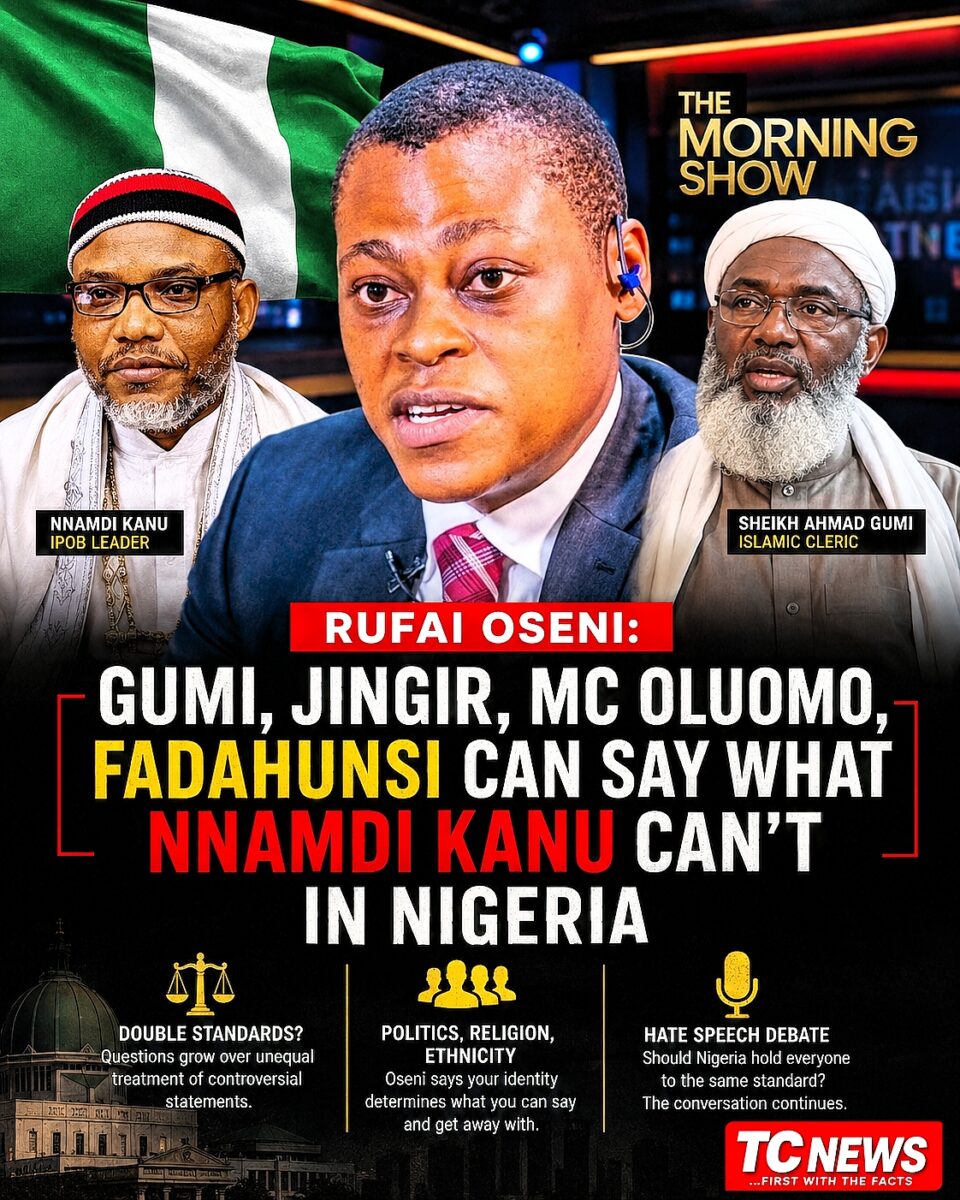
Arise Television broadcaster Rufai Oseni has accused the Nigerian government of applying what he described as a double standard in dealing with controversial, inflammatory and politically sensitive statements made by public figures.
Oseni argued that in Nigeria, the consequences of a statement often depend less on what was said and more on the political, religious, ethnic or social identity of the person who made it.
The broadcaster made the remarks on Thursday while discussing the controversy surrounding Senator Francis Fadahunsi and an alleged statement concerning members of the Accord Party ahead of the Osun State governorship election.
Oseni Questions Fadahunsi’s Defence
The controversy followed the circulation of a video in which Fadahunsi was allegedly heard making a statement interpreted by critics as a threat against political opponents.
However, the senator reportedly claimed that the video had been manipulated using artificial intelligence.
Oseni questioned the explanation, noting that Fadahunsi subsequently appeared to give a different interpretation of his remarks by saying he meant that he would defeat his political opponents through votes.
According to the broadcaster, the police would have sufficient grounds to investigate and potentially prosecute the senator if authorities were genuinely committed to confronting hate speech and inflammatory political rhetoric.
He also maintained that Fadahunsi should be given the opportunity to defend himself after questioning, regardless of whether a prosecution eventually resulted in a conviction.
However, Oseni expressed doubt that the senator would face serious consequences.
‘Some People Can Say Things and Get Away With It’
The Arise TV anchor said Nigeria has developed a system in which individuals are treated differently depending on their background and affiliations.
He cited Sheikh Ahmad Gumi and the convicted Indigenous People of Biafra, IPOB, leader Nnamdi Kanu, as examples of what he considers unequal treatment.
“The hypocrisy on which the country lives is that there are some that cannot say it. An example goes back to the case of the likes of Sheikh Gumi.
“They can say some things and get away with it. If you are probably an Nnamdi Kanu, you cannot say some things. That’s how the country is structured,” Oseni said.
He also referenced other politically prominent figures, including Senator Francis Fadahunsi and MC Oluomo, while making the broader argument that some Nigerians appear to have greater latitude when making controversial comments.
Religious Politics Also Comes Under Scrutiny
Oseni connected the controversy to Nigeria’s wider political and religious tensions.
He revisited his opposition to the Muslim-Muslim presidential ticket, saying his position was based on the need for religious balance in a country with significant Christian and Muslim populations.
According to him, political arrangements should take into consideration the country’s religious diversity and promote a sense of fairness among citizens.
The broadcaster also referred to a previously leaked audio involving former Labour Party presidential candidate Peter Obi and Bishop David Oyedepo.
In the recording, Obi was heard describing the 2023 presidential election as a “religious war.”
Oseni argued that subsequent public comments by Sheikh Gumi had, in his view, strengthened concerns that religion played a significant role in Nigeria’s political environment.
Political Identity and Free Speech Debate
Oseni’s central argument was that Nigeria’s handling of controversial speech is inconsistent.
He suggested that political affiliation, religion, ethnicity and other identity factors can influence whether an individual faces investigation, prosecution or public condemnation after making a contentious statement.
“So, what is said in Nigeria depends on where you are when you said it, your political affiliation, your religious affiliation, your racial affiliation, your tribal affiliation, that’s just it,” he said.
His comments have renewed debate over how Nigerian authorities should respond to inflammatory political speech, particularly as the country approaches important electoral contests.
The controversy also raises questions about the balance between freedom of expression, political criticism and the responsibility of public figures to avoid statements capable of inciting violence or deepening existing divisions.
Why This Matters
The debate over controversial statements is particularly important in Nigeria, where political competition can intersect with religious, ethnic and regional identities.
A consistent approach to inflammatory speech is therefore crucial. If similar statements receive different treatment depending on who makes them, public confidence in law enforcement and the justice system could suffer.
At the same time, allegations of inflammatory speech require due process. Investigations should establish the facts, determine the context of disputed statements and give accused individuals an opportunity to defend themselves.
The wider challenge for Nigeria is to ensure that freedom of expression is protected while genuine threats, incitement and hate speech are addressed according to clear and consistently applied laws.
FAQs
Who is Rufai Oseni?
Rufai Oseni is a Nigerian broadcaster and journalist who anchors programmes on Arise Television.
What did Rufai Oseni say about Nnamdi Kanu?
Oseni argued that some individuals, including Sheikh Ahmad Gumi, can make controversial statements without facing the same consequences that figures such as Nnamdi Kanu have faced.
What is the Fadahunsi controversy about?
Senator Francis Fadahunsi came under scrutiny over an alleged statement concerning members of the Accord Party ahead of the Osun State governorship election. He reportedly disputed the interpretation of the circulating video and claimed it had been manipulated using artificial intelligence.
What broader issue did Oseni raise?
He raised concerns about alleged double standards in Nigeria’s treatment of controversial speech, arguing that political, religious and ethnic identities can influence how statements are treated.
Conclusion
Rufai Oseni’s comments have placed Nigeria’s approach to inflammatory speech and political expression under renewed scrutiny.
While public officials and political actors must be held accountable for statements that could threaten public peace, Oseni’s argument is that accountability should be applied consistently, regardless of a person’s political, religious or ethnic identity.
As Nigeria’s political environment becomes increasingly competitive, the question of whether the same rules apply to everyone is likely to remain a major part of the national conversation.
👉 Do you agree with Rufai Oseni?
#RufaiOseni #NnamdiKanu #SheikhGumi #NigeriaPolitics #OsunElection #FrancisFadahunsi #HateSpeech #NigerianNews #TCNEWS
