

By MOHAMMED DANBABA
Retired Commander Accuses Former Administration of Silence After Major Counter-Terrorism Breakthrough
Focus Key Phrase: Buhari government unhappy with Shekau’s death
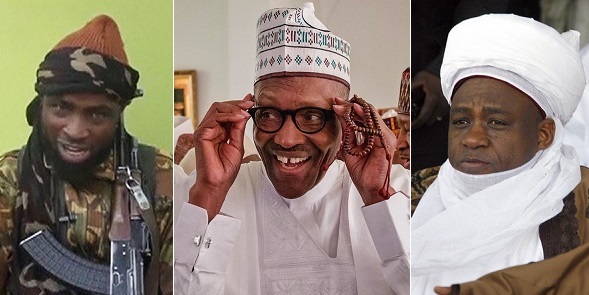
Retired Major General Danjuma Ali-Keffi has alleged that the Buhari government was unhappy with Shekau’s death, insisting that the administration deliberately refused to acknowledge or celebrate the killing of the Boko Haram leader despite its significance to Nigeria’s counter-terrorism efforts.
Ali-Keffi, who once headed Operation Service Wide (OSW) and served as General Officer Commanding 1 Division, made the revelation while recounting events surrounding the May 2021 elimination of Abubakar Shekau. According to him, the muted response directly contradicted global standards, especially the United States’ open celebration of Osama Bin Laden’s death.
Muted Reaction to a Major Victory
Ali-Keffi explained that he expected the Buhari administration to react strongly, given the years of atrocities linked to Shekau. Instead, he noted, the government publicly acted as though nothing had happened. He compared it to how President Barack Obama openly hailed the success of the SEAL Team Six raid that killed Bin Laden.
He said he briefed the former president on the success of the mission, yet not even a private commendation followed.
“Despite briefing the late President Buhari of our success in eliminating Shekau, we did not receive even a ‘well done,’” he stated.
The retired general added that he did not expect a public announcement because OSW operated covertly, but he expected leadership to at least recognize the accomplishment internally.
Shekau Was Not Boko Haram’s True Leader
The retired commander also clarified that Shekau, despite his infamy, was not Boko Haram’s topmost figure. Intelligence reports from the UAE and a major Western country identified Alhaji Saidu Ahmed as the organisation’s financial backbone and strategic leader. His arrest severely weakened the group and set in motion several events that paved the way for Shekau’s eventual death.
However, Ali-Keffi stressed that Saidu’s release under “questionable circumstances” allowed Boko Haram to regain strength.
This aligns with earlier investigative findings published by SaharaReporters, which identified Saidu as the foremost financier among 23 individuals linked to terrorism funding. Nigerian intelligence tracked N4.8 billion in suspicious flows into his accounts, revealing ties to multiple convicted associates.
Government Neglect and Financial Starvation of OSW
Another concern raised by Ali-Keffi was the government’s alleged refusal to release funds for OSW even after formally extending the operation until June 2022. Instead, he said he was encouraged to “source funds” privately, forcing him to finance critical missions with personal resources.
> “The former president approved funds for the extension, but up to the day I was arrested, not a kobo was released,” he said.
“Is this not curious for such a sensitive and expensive endeavour?”
He argued that withholding funds undermined the mission’s capacity to maintain pressure on terror cells and sustain intelligence networks already embedded in hostile territories.
Attempt to Claim Credit and Compromise Operations
Ali-Keffi also disclosed that the former Director of the Nigerian Financial Intelligence Unit (NFIU), Hamman-Tukur Modibbo, attempted to organise a joint press conference to claim credit for the operation. He resisted, warning that such exposure would threaten infiltrated operatives and jeopardise ongoing missions across the North-East.
His refusal, he said, strained relations further and contributed to a climate of hostility around the operation’s leadership.
How Internal Rivalries Triggered Shekau’s Downfall
The retired general credited the ultimate success of the mission to the intelligence brilliance of the late Brigadier General Abdulrahman Kuliya. Kuliya devised a strategic plan that exploited tensions between Boko Haram and ISWAP, intentionally fuelling internal clashes that weakened Shekau’s faction before the final strike.
He described Kuliya as “the mastermind” whose work gave OSW the upper hand in one of Nigeria’s most consequential counter-terrorism victories.
A Victory Left Uncelebrated
By the time Shekau died, Ali-Keffi expected the Buhari government to highlight it as a major national achievement. Instead, the event disappeared from official narratives, with neither acknowledgment nor gratitude directed at the operatives who risked their lives.
According to him, the silence sent a troubling message to security personnel and suggested internal political discomfort around the fall of the country’s most iconic insurgent figure.
The revelations have now reignited questions about the Buhari administration’s handling of intelligence, counter-terrorism priorities and internal political dynamics during its eight-year tenure.
—
#Shekau #Buhari #AliKeffi #BokoHaram #Terrorism #NigeriaSecurity #CounterTerrorism #BreakingNews
