

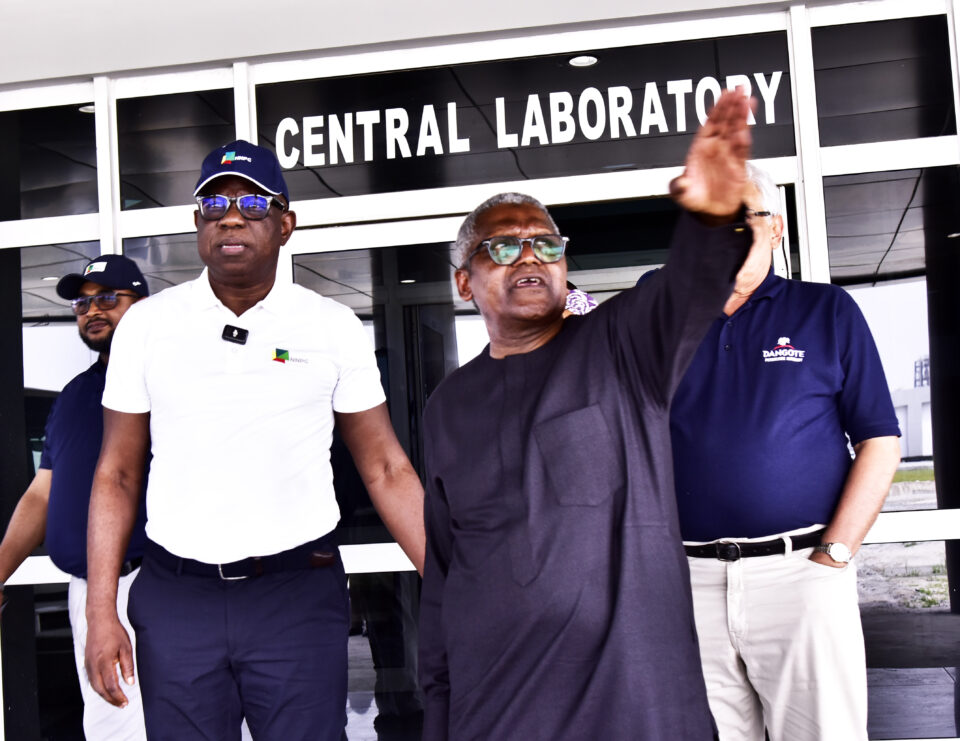
Caption: L-R, Group Chief Executive Officer of the Nigerian National Petroleum Company (NNPC), Engr. Bayo Bashir Ojulari; President/ CE, Dangote Industries limited, Aliko Dangote; During the Group Chief Executive Officer Members of the Board and Executive Management Team of Nigerian National Petroleum Company Limited Visit to Dangote Petroleum Refinery and Fertiliser in Lekki Lagos on Saturday February 2026.
By DAYO ADESULU
Nigeria’s energy sector may be entering its most defining chapter yet as the Dangote Refinery and NNPC strategic alliance takes center stage. In what industry watchers describe as a landmark development, and have pledged deeper collaboration to secure Nigeria’s energy future and accelerate industrial transformation.
The renewed partnership unfolded during a high-level visit by NNPC Ltd.’s leadership to the sprawling Dangote Refinery and Petrochemicals complex in Ibeju-Lekki, Lagos. Both sides made it clear: the era of rivalry and fragmentation must give way to cooperation, efficiency, and shared national purpose.
Turning a Vision Into National Strategy
President of , , described the collaboration as a return to the original dream that birthed the refinery project.
He stressed that the Dangote Refinery was never meant to operate in isolation. Instead, it was designed as a catalyst for broader economic transformation — not just for Nigeria, but for Africa as a whole.
According to Dangote, the Dangote Refinery and NNPC strategic alliance holds the potential to revolutionize energy supply chains across the continent. He commended the new leadership at NNPC Ltd., noting that the fresh approach signals readiness for practical, results-driven engagement.
With NNPC Ltd. holding a 7.25 percent equity stake in the refinery on behalf of Nigerians, Dangote emphasized that collaboration should deepen within the existing industrial ecosystem rather than duplicate investments elsewhere. He argued that aligning capacities would unlock stronger value creation and avoid wasteful competition.
Beyond Fuel: Building an Industrial Powerhouse
Importantly, Dangote revealed that the refinery is evolving into a fully integrated industrial hub. While fuel refining remains central, the future lies in high-margin petrochemicals.
One of the flagship expansion projects includes a 400,000 metric tonne Linear Alkyl Benzene (LAB) facility — a scale projected to exceed Africa’s current production capacity. LAB is a key raw material used in detergents and other industrial applications, positioning Nigeria as a potential continental leader in petrochemical manufacturing.
Dangote explained that refining alone does not maximize economic value. Instead, processing raw materials domestically into high-value petrochemicals strengthens foreign exchange earnings, boosts industrialization, and reduces reliance on imports.
The message was clear: Nigeria must move from exporting crude to exporting finished and semi-finished products.
NNPC Signals Break from the Past
On his part, the Group Chief Executive Officer of NNPC Ltd., , pledged that the company is charting a new course grounded in transparency, accountability, and partnership.
Ojulari acknowledged that past operational models had limited productivity. However, he stressed that the current leadership intends to consolidate viable proposals into a structured joint framework with Dangote Refinery.
“The whole idea,” he noted, “is to examine where we are, identify opportunities, and take practical steps forward.”
Significantly, he described the Dangote Refinery and NNPC strategic alliance as a collaboration between “national champions” capable of redefining Nigeria’s energy security architecture.
Refinery Surpasses Design Capacity
During the facility tour, officials observed the refinery operating at 661,000 barrels per day — exceeding its 650,000 barrels-per-day nameplate capacity. For many observers, this milestone underscores both operational strength and technological sophistication.
Ojulari admitted that initial projections never anticipated such rapid scaling. Yet, live operational parameters confirmed the refinery’s capacity performance.
Industry analysts say this development could significantly reduce Nigeria’s dependence on imported refined petroleum products. For decades, Africa’s largest oil producer paradoxically relied on foreign refineries despite abundant crude reserves. However, with the refinery now exceeding design output, the narrative may finally be shifting.
Strategic Implications for Nigeria and Africa
The Dangote Refinery and NNPC strategic alliance carries implications far beyond fuel supply.
First, it strengthens Nigeria’s bargaining power in global energy markets. Second, it supports foreign exchange stability by cutting import bills. Third, it enhances job creation across manufacturing, logistics, and petrochemicals.
Moreover, both institutions committed to identifying priority collaboration areas in the coming weeks. They aim to develop a structured implementation roadmap that translates policy intent into measurable results.
Energy experts believe this cooperation could mark the beginning of a coordinated national energy strategy rather than fragmented industrial efforts.
A Partnership to Watch
For years, Nigeria’s oil and gas sector faced structural inefficiencies, policy uncertainties, and underperforming assets. Therefore, this renewed alignment between private sector capital and state energy authority represents a strategic recalibration.
Both Dangote and Ojulari reiterated a shared commitment to value creation, not mediocrity. They emphasized honest dialogue, practical solutions, and national interest as guiding principles.
As the Dangote Refinery and NNPC strategic alliance begins to take shape, stakeholders across Africa will be watching closely. If successfully implemented, the partnership could redefine Nigeria’s energy narrative — from importer to exporter, from fragmented operator to integrated powerhouse.
The coming weeks will determine how quickly both parties translate commitments into action. Yet one thing is evident: Nigeria’s energy future now rests on cooperation, not competition.
#DangoteRefinery #NNPC #EnergySecurity #NigeriaEconomy #Industrialization #OilAndGas #AfricaRising
