

By MOHAMMED DANBABA
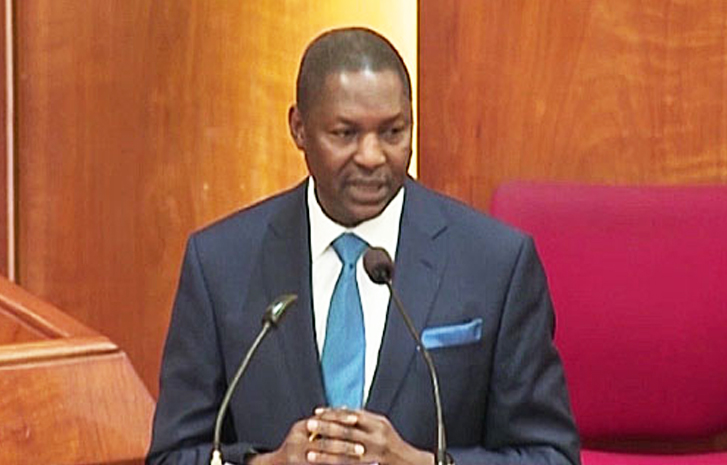
Former Attorney-General of the Federation and Minister of Justice, Abubakar Malami, SAN, is facing one of the most far-reaching corruption cases involving a former top public official in recent years, following the filing of 16 criminal counts by the Federal Government over alleged large-scale money laundering and unlawful acquisition of assets.
Court documents filed before the Federal High Court in Abuja show that Malami, his son Abubakar Abdulaziz Malami, and an associate, Hajia Bashir Asabe, are accused of laundering ₦8.7 billion through a complex web of corporate fronts, proxy transactions, and property acquisitions spanning almost a decade.
Prosecutors allege that the offences occurred between 2015 and 2025, covering Malami’s tenure as Nigeria’s chief law officer and extending beyond his time in office.
Alleged Use of Corporate Fronts to Conceal Illicit Funds
According to the charge sheet, the defendants allegedly used companies including Metropolitan Auto Tech Limited, Rahamaniyya Properties Limited, and Meethaq Hotels Limited to conceal, retain, disguise, and convert funds suspected to be proceeds of unlawful activities.
Investigators claim these entities served as conduits for laundering money through bank accounts, cash collaterals, and property purchases, with the accused persons allegedly aware of the illegal origin of the funds.
One of the central allegations is that ₦1,014,848,500 was lodged into a Sterling Bank Plc account operated by Metropolitan Auto Tech Limited between July 2022 and June 2025, with prosecutors insisting that Malami and his son knew the funds were illicit.
In a similar count, the Federal Government alleged that between September 2020 and February 2021, another ₦600,013,460.40 was concealed through the same account while Malami was still serving as Attorney-General.
Cash Collateral and Hotel Transactions Under Scrutiny
The charge sheet further alleges that in March 2021, Malami and his son retained ₦600 million as cash collateral through Metropolitan Auto Tech Limited to secure a ₦500 million loan from Sterling Bank for Rayhaan Hotels Limited, despite allegedly knowing the funds were unlawful.
Additionally, prosecutors accused the defendants of disguising the source of ₦500 million paid in November 2022 to Efab Properties Limited for the purchase of a luxury duplex located at Amazon Street, Maitama, Abuja.
Between November 2022 and September 2024, the defendants allegedly conspired to conceal ₦1.049 billion paid through Meethaq Hotels Limited’s Union Bank account, while another ₦1.36 billion was allegedly controlled indirectly through the same account between November 2022 and October 2025.
Luxury Properties Across Abuja, Kano, and Kebbi
Beyond cash transactions, the Abubakar Malami money laundering charges also revolve heavily around high-value real estate acquisitions allegedly funded with illicit proceeds.
Court documents list multiple properties, including:
₦700 million paid between November and December 2018 for No. 3 Onitsha Crescent, Area 11, Garki, Abuja
₦850 million paid between September and December 2020 for Plot 683, Jabi District, Abuja
₦430 million paid in February 2018 for No. 3 Rhine Street, Maitama, Abuja
₦210 million paid for a property in Asokoro District, Abuja
₦325 million allegedly disguised between March and June 2021 to acquire property at Yakubu Gowon Crescent, Asokoro
₦120 million used between 2015 and 2016 to purchase a property in Gwarimpa, Abuja
Prosecutors also allege that between June 2022 and January 2023, ₦537 million was used to acquire properties in BUA Estate, Abuja; Birnin Kebbi; and Nassarawa GRA, Kano.
Another count accuses Malami of concealing ₦415 million between October 2018 and December 2021 to acquire multiple properties, including a plaza near Birnin Kebbi Market, vast farmland along Birnin Kebbi–Jeba Road, and high-end residences in Abuja and Kano.
₦212.8bn Worth of Properties Under Investigation
Earlier reports revealed that investigators have identified 30 properties allegedly linked to Malami, valued at approximately ₦212.8 billion, spread across Kebbi State, Kano State, and the Federal Capital Territory.
The documents, titled Approximate Property Valuing and Abubakar Malami Identified Properties, are now central to the prosecution’s case and are expected to form the basis of forfeiture proceedings if convictions are secured.
Legal Framework and Wider Implications
All the alleged acts are said to contravene provisions of the Money Laundering (Prohibition) Act 2011 (as amended) and the Money Laundering (Prevention and Prohibition) Act 2022.
Legal observers say the case could mark a defining moment in Nigeria’s anti-corruption efforts, particularly because it targets a former Attorney-General who once oversaw the nation’s justice system.
As the trial unfolds, public attention is expected to remain sharply focused on whether the prosecution can successfully prove the allegations and whether the courts will order the recovery of assets allegedly acquired with public funds.
#AbubakarMalami
#MoneyLaunderingCharges
#NigeriaCorruption
#FederalHighCourt
#AntiCorruption
