

By LEVI JOHNSON
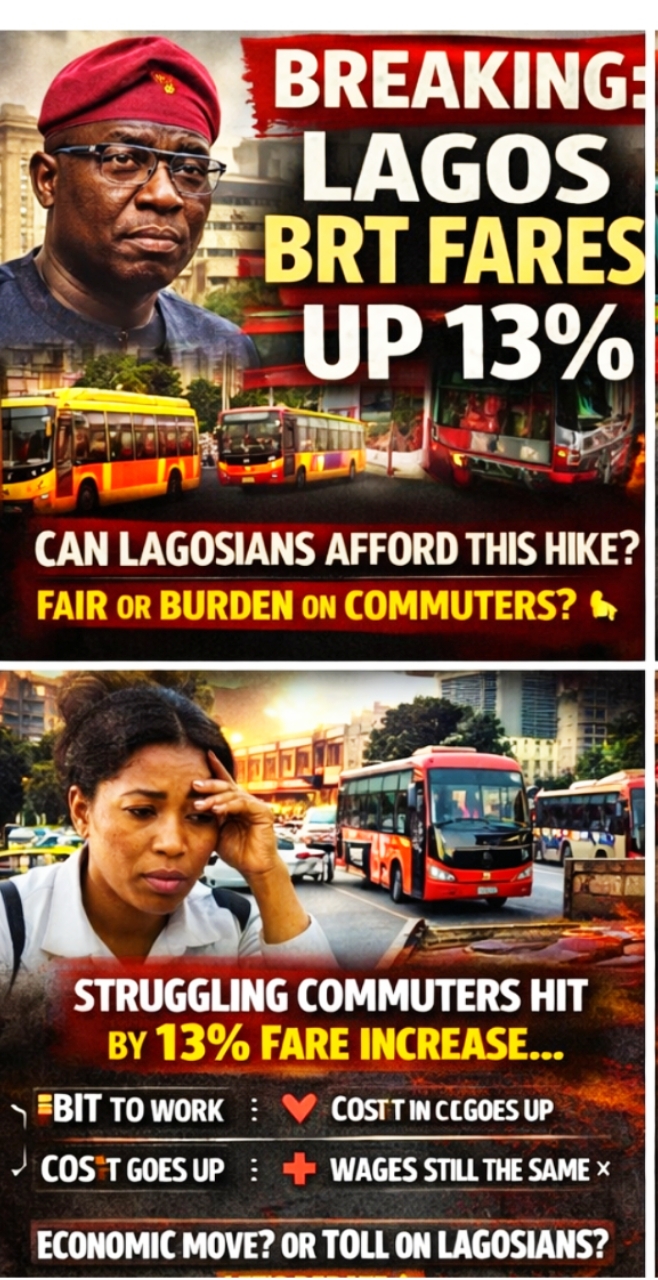
The 13% BRT fare increase in Lagos will take effect from March 2 after Governor Babajide Sanwo-Olu approved a review of fares across all Bus Reform Initiative (BRI) schemes, including Bus Rapid Transit (BRT) and standard bus routes.
The decision, announced by the Lagos Metropolitan Area Transport Authority (LAMATA), follows mounting concerns from regulated transport operators about the sustainability of public transport services under prevailing economic pressures.
Why the 13% BRT Fare Increase in Lagos Was Approved
In a statement released on Monday, Kolawole Ojelabi, Head of Corporate Communication at LAMATA, said the fare adjustment became necessary due to rising operational costs and inflationary trends affecting the transport sector.
According to him, the review aligns with the state’s previously approved annual fare adjustment mechanism. However, this year’s increase carries greater urgency as inflation continues to strain both operators and commuters.
Data from the National Bureau of Statistics (NBS) showed that Nigeria’s inflation rate closed 2025 at 15.2 percent. Transport operators argue that the rising cost of fuel, spare parts, vehicle maintenance, and wages has significantly increased the burden of running daily services.
Consequently, the 13% BRT fare increase in Lagos is positioned as a measure to cushion the financial pressure on Bus Operating Companies (BOCs).
Operators Face Mounting Operational Costs
Transport companies operating under the BRI scheme have reportedly struggled with escalating expenses. Beyond inflation, the implementation of the new national minimum wage has also raised staff salary obligations.
Furthermore, operators have continued to invest in modern fleets to maintain service standards. According to LAMATA, several companies are procuring cleaner, more fuel-efficient buses to improve passenger comfort and promote environmental sustainability.
These investments, officials say, require stable revenue streams. Therefore, the fare adjustment aims to prevent service disruptions while ensuring reliability across routes.
What Commuters Should Expect
From March 2, passengers using BRT and standard BRI routes will pay 13 percent more than current fares. Although authorities did not immediately publish a detailed breakdown of the new fare structure, commuters across Lagos are expected to feel the impact.
Lagos remains Nigeria’s commercial nerve centre, with millions relying daily on public transport to commute between residential areas and business districts. The BRT system, in particular, serves as a major mobility backbone within the state.
However, the fare hike comes at a time when many residents already face increased living costs. As a result, reactions from commuters may be mixed.
Government’s Position on Affordability and Sustainability
Despite the increase, the Lagos State Government insists it remains committed to balancing affordability with operational sustainability.
LAMATA emphasized that maintaining safe, reliable, and efficient transportation requires consistent funding. Authorities argue that without periodic reviews, service quality could decline due to underfunding.
Officials also reiterated that the state continues to prioritize transport reforms aimed at easing congestion and improving urban mobility.
Broader Economic Context
The 13% BRT fare increase in Lagos reflects broader economic realities affecting multiple sectors across Nigeria. Inflation, currency volatility, and rising import costs have collectively driven up the price of goods and services nationwide.
In the transport sector specifically, spare parts and vehicle components often depend on foreign exchange. As exchange rates fluctuate, operators experience higher procurement costs.
Moreover, fuel pricing dynamics continue to influence transport operations, further tightening margins for service providers.
Given these factors, policymakers argue that fare adjustments, though difficult, remain necessary to prevent systemic breakdowns.
Implications for Urban Mobility
Urban planners note that efficient public transport systems are vital for megacities like Lagos. Any disruption in BRT operations could worsen traffic congestion and productivity losses.
Therefore, the fare adjustment may serve as a preventative measure to stabilize the system. However, sustained dialogue between government and commuters will likely determine public acceptance.
As implementation approaches, stakeholders across the state will monitor how the 13% BRT fare increase in Lagos affects ridership patterns and commuter behaviour.
For now, the decision underscores the delicate balance between economic sustainability and public affordability in Nigeria’s largest city.
#SanwoOlu #LagosTransport #BRTFareIncrease #LAMATA #LagosNews #NigeriaEconomy
