

By DAYO ADESULU
Push for Inclusive Financing Gains Momentum in Lagos
Lagos, Nigeria — Sterling Bank has intensified its push for gender-inclusive financing with a high-level stakeholder engagement aimed at unlocking capital for women entrepreneurs across Nigeria.
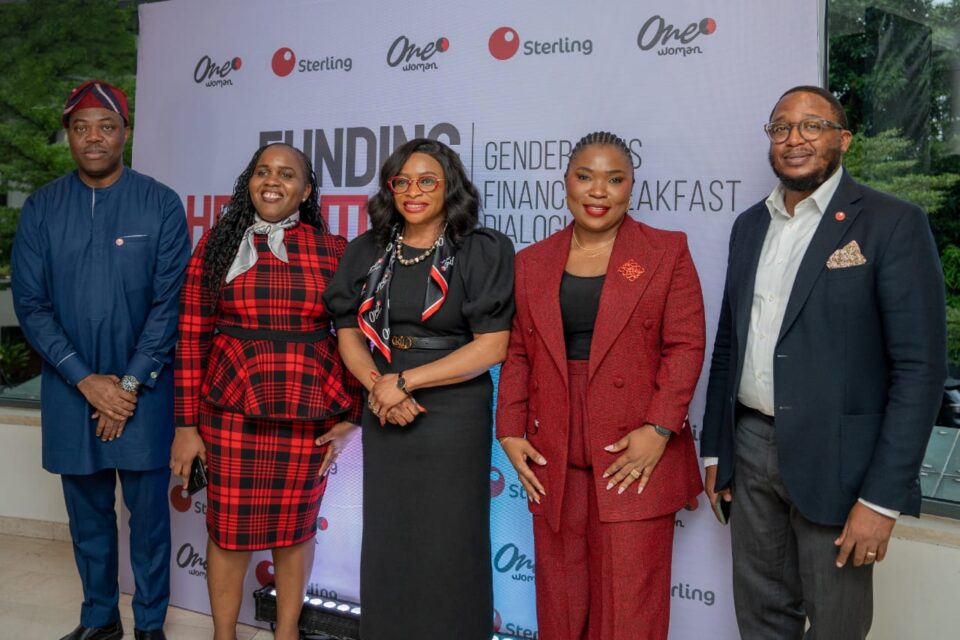
Through its flagship women-focused initiative, OneWoman Initiative, the bank convened the Funding Her Future Breakfast Dialogue, drawing participation from development finance institutions, ecosystem leaders, entrepreneurs, and private sector stakeholders.
The event created a platform for a frank and solutions-driven conversation around one central issue: how to expand access to sustainable and scalable financing for women-led businesses.
From Conversation to Action
Speaking at the gathering, the Managing Director and CEO of Sterling Bank, Abubakar Suleiman, stressed that the dialogue was designed to move beyond rhetoric.
He made it clear that stakeholders must transition from shared intentions to measurable outcomes that directly impact women entrepreneurs.
Represented by Chief Growth Officer Edward Ogunmekan, Suleiman described the forum as a convergence point for finance, enterprise, inclusion, and sustainable growth.
He framed the discussion around a critical question: how Nigeria can build financing systems that are not only accessible but also commercially viable and long-lasting for women-led ventures.
According to him, the bank’s commitment is rooted in a long-standing belief that real economic prosperity comes from supporting people and ideas with strong growth potential.
Beyond Capital: Building a Support System
While access to funding remained central to the discussions, participants emphasized that financing alone cannot solve the challenges facing women entrepreneurs.
Instead, the dialogue focused on building a complete ecosystem—one that integrates capital, business readiness, mentorship, and institutional partnerships.
Suleiman explained that this philosophy forms the backbone of the OneWoman Initiative, which operates across three pillars: capital, capacity, and community.
He noted that without the right networks and support structures, many women-led businesses struggle to scale, even when funding is available.
$42 Billion Financing Gap Raises Urgency
The urgency of the conversation was further underscored by data shared during the event.
Head of the OneWoman Initiative, Ezinne Nwokafor, revealed that women entrepreneurs in Nigeria face a staggering $42 billion annual financing gap, citing estimates from the International Finance Corporation.
She pointed out that despite gradual improvements in financial inclusion, a significant number of Nigerian women remain excluded from formal credit systems.
More than half of women-led businesses, she noted, identify access to finance as a major barrier to growth. Even more concerning, loan rejection rates for women remain significantly higher than those for men.
Nwokafor linked these challenges to structural issues, including limited asset ownership, restrictive social norms, and insufficient financial visibility.
However, she also highlighted a major opportunity: bridging this gap could unlock massive economic potential and accelerate national development.
Measurable Impact and Ambitious Targets
The OneWoman Initiative is already making notable progress.
According to Nwokafor, the programme disbursed ₦43.9 billion in loans to 2,450 female entrepreneurs in 2025 alone. Beyond funding, it has also provided training for over 6,000 women and reached approximately 380,000 participants across three segments—career women, women in business, and fresh graduates.
Looking ahead, the initiative has set an ambitious target: ₦500 billion in loans to one million women by 2030.
This long-term vision reflects a broader strategy to not only close the financing gap but also strengthen the entire ecosystem supporting women entrepreneurs.
Stakeholders Highlight Role of Capacity Building
Adding to the conversation, Divisional Head of Commercial Banking, Akporee Idenedo, emphasized the importance of skills development.
He noted that building entrepreneurial capacity remains essential for sustaining growth and ensuring that businesses can effectively utilize financing.
Panel sessions at the event reinforced this position, offering practical insights into available funding opportunities while also addressing gaps in mentorship, policy support, and institutional collaboration.
A Broader Strategy for Economic Growth
The Funding Her Future Breakfast Dialogue forms part of Sterling Bank’s wider strategy to deepen support for women through targeted financing, enterprise development, and community-driven initiatives.
By strengthening platforms like OneWoman, the bank aims to empower women not only to build sustainable businesses but also to create jobs and contribute meaningfully to Nigeria’s economic growth.
With increasing recognition of the economic role women play—particularly in the micro, small, and medium enterprise sector—stakeholders agree that closing the financing gap is no longer optional.
Instead, it has become a critical step toward building a more inclusive and resilient economy.
#SterlingBank #OneWoman #WomenEntrepreneurs #FinancialInclusion #NigeriaBusiness #SMEs #EconomicGrowth #WomenInBusiness
