

By LEVI JOHNSON
The U.S. Department of Defense begins mapping a possible military operation in Nigeria after Donald Trump’s directive, raising fears of regional instability and renewed global tension.
—
Introduction: Pentagon Begins Mapping Military Options in Nigeria
In a development that has sent ripples through global defense and diplomatic circles, the U.S. Department of Defense has begun mapping potential military operations in Nigeria, following a direct order from former President Donald Trump.
The move, reportedly aimed at countering the violent insurgencies of Boko Haram and Islamic State West Africa Province (ISWAP), has raised alarm among analysts who warn that any U.S. military involvement could destabilize the West African region and complicate ongoing counterterrorism efforts.
—
1. Trump’s Directive: “Prepare for Possible Action”
Over the weekend, Donald Trump announced via his social media channels that he had instructed the Pentagon to “prepare for possible action” in Nigeria to protect what he described as “cherished Christians under attack.”
The directive, while framed as a humanitarian mission, has been viewed with skepticism by defense and intelligence officials, who say the order carries significant political undertones and lacks a clear operational objective.
—
2. Pentagon Response: Contingency Plans Underway
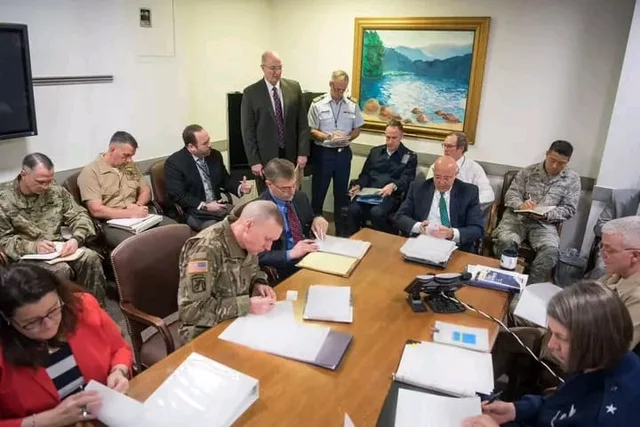
Sources inside the U.S. Department of Defense confirmed that the Joint Staff and U.S. Africa Command (AFRICOM) have drafted three operational plans — labeled light, medium, and heavy — each representing escalating levels of involvement.
2.1. The “Light” Option
This scenario would see the U.S. provide intelligence, surveillance, and reconnaissance (ISR) support to Nigerian forces battling Boko Haram and ISWAP in the northeast. Such support could include drone surveillance and target tracking.
2.2. The “Medium” Option
The second plan involves limited drone strikes using MQ-9 Reaper and MQ-1 Predator aircraft. However, this has been complicated by the loss of two key drone bases in Niger — Agadez and Niamey — now reportedly under Russian control.
2.3. The “Heavy” Option
The final and most aggressive plan includes the deployment of a U.S. aircraft carrier to the Gulf of Guinea, supported by long-range bombers capable of striking deep inside northern Nigeria. Pentagon insiders, however, argue that such a deployment would strain existing U.S. commitments in the Middle East, Pacific, and South America.
—
3. Military Experts Warn of “Symbolic but Risky” Intervention
Many U.S. defense analysts have expressed doubts about the effectiveness of a U.S.-led military campaign in Nigeria’s volatile north.
Retired Maj. Gen. Paul D. Eaton, a veteran of the Iraq War, cautioned that “airstrikes alone might shock and awe but won’t solve decades of sectarian violence.”
Experts note that Nigeria’s crisis is multi-layered, involving ethnic disputes, land conflicts between farmers and herders, political corruption, and religious extremism — factors that make external military intervention a highly delicate affair.
—
4. Nigeria’s Reaction: Welcome Support, but Sovereignty First
In response, the Nigerian government has expressed cautious optimism. Officials welcomed potential U.S. intelligence and logistical support, but warned that any intervention must respect Nigeria’s sovereignty and territorial integrity.
A senior defense official in Abuja stated, “We appreciate global concern, but Nigeria’s fight against terrorism must remain a Nigerian-led effort.”
—
5. AFRICOM’s Strategic Planning and Deployment Timeline
The U.S. Africa Command (AFRICOM), headquartered in Stuttgart, Germany, has forwarded the operational blueprints to Washington for final assessment.
Sources say Gen. Dagvin R. M. Anderson, AFRICOM’s newly appointed commander, is expected to visit Nigeria next month for high-level consultations with top Nigerian military officials. The visit will focus on intelligence sharing, counterinsurgency cooperation, and possible joint tactical exercises.
—
6. Political and Global Implications
6.1. U.S.–Russia–China Rivalry in Africa
Trump’s move comes amid a growing geopolitical competition in Africa. Both Russia and China have expanded their footprints across the continent, including in the Sahel region.
Analysts say this renewed U.S. focus may be part of a strategic push to reassert American influence after recent losses of military bases in Niger.
6.2. Domestic Political Undertones
Critics argue that the former president’s order may also be politically motivated, aimed at rallying conservative evangelical support ahead of a potential 2028 campaign.
—
7. Analysts Urge Diplomacy Over Force
International analysts have called for diplomatic engagement and regional cooperation instead of unilateral military action.
A senior defense scholar told VerseNews that “Nigeria’s instability is deeply rooted — military might alone cannot fix governance failures, poverty, or ethnic tension.”
The expert emphasized that any intervention should be coordinated through ECOWAS and the African Union, not imposed externally.
—
Conclusion: Balancing Security and Sovereignty
As the U.S. Department of Defense continues mapping potential military operations in Nigeria, global leaders are urging restraint and diplomacy.
While the move reflects a renewed U.S. interest in West Africa, experts caution that intervention without deep regional understanding could inflame tensions rather than resolve them.
The coming weeks — particularly Gen. Anderson’s visit to Nigeria — may determine whether Washington’s plans evolve into partnership or confrontation.
—
FAQs on U.S. Department of Defense Military Operation in Nigeria
1. What triggered the U.S. Department of Defense’s planning in Nigeria?
An order from former U.S. President Donald Trump directing the Pentagon to “prepare for possible action” against Islamist militants.
2. What are the three military options under review?
Light (surveillance support), medium (limited drone strikes), and heavy (carrier deployment and deep strikes).
3. How has Nigeria reacted?
Nigeria welcomed U.S. support but emphasized that any intervention must respect its sovereignty and be Nigeria-led.
4. Why are U.S. analysts skeptical?
They warn that external force alone cannot solve Nigeria’s complex, decades-long insurgency.
5. How does this affect U.S.–Africa relations?
It signals renewed U.S. military interest in Africa amid increasing Russian and Chinese influence on the continent.
6. What’s next?
AFRICOM’s Gen. Anderson is scheduled to visit Nigeria to discuss possible collaboration and the next phase of planning.
