

By DAYO ADESULU
When I checked the 1999 Constitution of Nigeria, the Administration of Criminal Justice Act (ACJA), relevant judicial principles on adjournment/stay of proceedings, and the latest reports concerning the DSS–Omoyele Sowore case. This is what I discovered.
There is an important legal distinction here: the DSS can instruct its lawyers to ask the court for an adjournment, but the DSS cannot itself suspend a case or unilaterally decide when a judicial proceeding will resume. That power belongs to the court, subject to the applicable law.
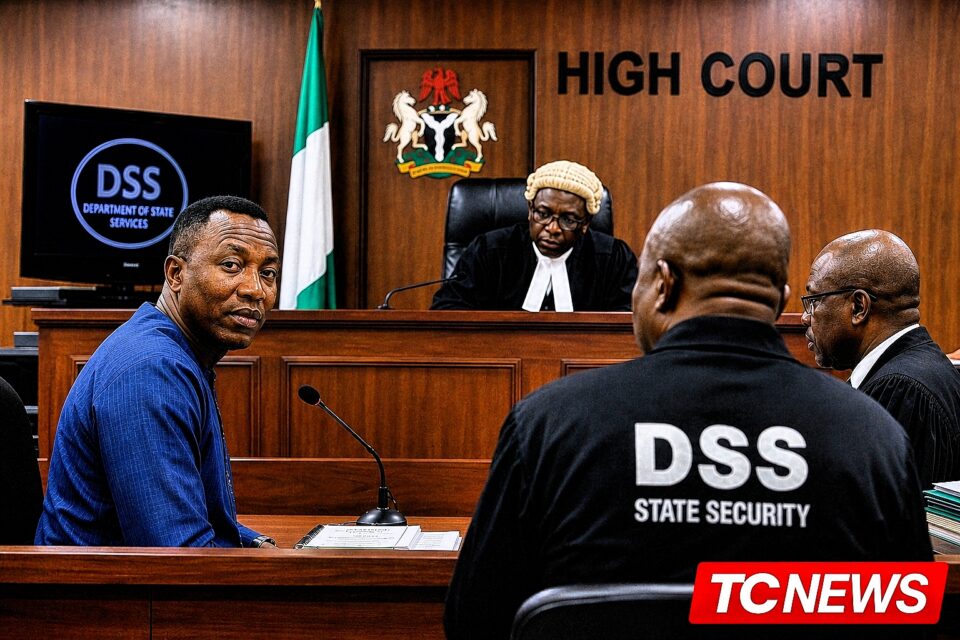
The reported position is that the DSS has instructed its counsel, Akinlolu Kehinde, SAN, to seek an adjournment of Sowore’s cybercrime case until after the 2027 presidential election. Counsel has confirmed that he will seek the court’s indulgence. The matter is expected to come before the Federal High Court after the judicial vacation.
The short legal answer
No — a prosecutor does not have the unilateral legal power to “suspend” an ongoing court case and dictate that it should resume at a particular future date.
What the prosecutor can do is:
- Apply for an adjournment;
- Apply to withdraw/discontinue the prosecution where the law permits;
- Inform the court that the prosecution does not intend to proceed at a particular sitting;
- In appropriate circumstances, seek the Attorney-General’s intervention or direction.
But the court decides whether an adjournment is granted and for how long.
That distinction is extremely important in the Sowore matter.
1. Who controls a case once it is before a court?
This is where the DSS’s language needs to be carefully examined.
Once a criminal proceeding is properly before a court, the case becomes a judicial proceeding. The prosecutor remains responsible for presenting the prosecution, but the prosecutor does not become the owner of the court’s calendar.
The court controls its proceedings.
This is consistent with the constitutional architecture of judicial independence. The Constitution gives judicial power to the courts, while section 36 guarantees a person charged with a criminal offence a fair hearing within a reasonable time.
Therefore, the DSS can say to its lawyers:
“We want you to request an adjournment.”
But it cannot legally say:
“The case is suspended until after the 2027 election.”
That second proposition would require a judicial order or another legally recognised method of terminating/discontinuing the proceeding.
And that distinction is not merely semantic.
2. What does the Constitution say?
The most important constitutional provision here is Section 36(4) of the 1999 Constitution.
It provides that a person charged with a criminal offence is entitled, unless the charge is withdrawn, to a fair hearing in public within a reasonable time by a court or tribunal.
This creates an interesting situation.
The constitutional protection is principally a protection for the accused, but it also reinforces the principle that criminal cases should not be unnecessarily dragged out.
A criminal trial is not supposed to be:
Start today → stop whenever the prosecution wants → resume whenever the prosecution considers convenient.
The judicial process must move according to law.
The Supreme Court has also recognised that “reasonable time” depends upon the circumstances of each case, including the complexity and nature of the proceedings. It does not mean that every adjournment is unconstitutional.
So an adjournment itself is not unlawful.
The question is:
Is the proposed adjournment reasonable, necessary and judicially justified?
That is where the DSS’s position becomes legally interesting.
3. Can DSS lawyers ask for an adjournment?
Absolutely.
There is nothing inherently unlawful about a prosecutor asking a court for an adjournment.
In fact, courts routinely grant adjournments for legitimate reasons:
- absence of a material witness;
- illness of counsel;
- outstanding evidence;
- disclosure issues;
- constitutional applications;
- administrative difficulties;
- exceptional circumstances;
- or other circumstances necessary to ensure justice.
But an application for adjournment is just that:
an application.
It is not an automatic order.
The judge must decide whether to grant it.
And this is particularly important in the Sowore case because the court had previously insisted on progressing the matter.
In July 2026, the Federal High Court reportedly warned that Sowore’s defence could be foreclosed after the prosecution complained about repeated adjournment requests. The judge nevertheless granted another adjournment in the interest of fair hearing and warned that further failure to proceed could have consequences.
That history makes the present development even more interesting.
4. Can the DSS tell the court: “We want the case to resume after the election”?
It can ask.
It cannot command.
The court is not administratively subordinate to the DSS.
The DSS is an executive security agency. Its counsel represents the prosecution before the court. But once the matter is before the Federal High Court, the judge controls the proceedings.
So, legally, the proper formulation is:
“The prosecution respectfully applies for an adjournment until [date], for the following reasons…”
Not:
“The DSS has suspended the case until after the election.”
The latter could give the impression that the executive agency believes it possesses authority over the judicial timetable.
It does not.
5. There is an even more important provision: Section 306 ACJA
This is one of the strongest points in the analysis.
Section 306 of the Administration of Criminal Justice Act 2015 provides:
“An application for stay of proceedings in respect of a criminal matter before the Court shall not be entertained.”
Nigerian appellate courts have repeatedly considered this provision in relation to attempts to halt criminal proceedings.
Therefore, if by “suspend” the DSS means a formal stay of proceedings, that raises a much more serious legal problem.
A stay is fundamentally different from an ordinary adjournment.
Adjournment
The court says:
“We will continue this case on another date.”
Stay
The proceedings are effectively put on hold pending some event or determination.
The ACJA specifically restricts applications for stay of criminal proceedings.
Therefore, the DSS lawyers would need to be very careful about the terminology and legal basis of what they are asking for.
Calling something an “adjournment” does not automatically make it lawful if its substance is effectively an attempt to stay the proceedings indefinitely.
6. What about withdrawal of the prosecution?
This is where the law gives prosecutors considerably more room.
Under Section 108 of the ACJA, a prosecutor may, or on the instruction of the Attorney-General of the Federation in the relevant circumstances, withdraw a criminal charge before judgment. The consequences depend on the stage of the proceedings.
There is also the constitutional power of the Attorney-General of the Federation under Section 174.
Section 174 empowers the Attorney-General to:
- institute criminal proceedings;
- take over and continue criminal proceedings instituted by another authority; and
- discontinue criminal proceedings before judgment.
But the Constitution expressly requires the Attorney-General, when exercising these powers, to have regard to:
public interest, the interest of justice and the need to prevent abuse of legal process.
This is very important.
The DSS itself does not possess the constitutional nolle prosequi/discontinuance power under Section 174.
That constitutional power belongs to the Attorney-General of the Federation in federal criminal matters.
7. So who is actually prosecuting Sowore?
This needs careful terminology.
The DSS instituted the proceeding and is represented by counsel. Current reports describe the DSS as prosecuting Sowore.
The Federal Ministry of Justice itself explains that public prosecution involves the Attorney-General’s constitutional powers, while the Department of Public Prosecutions can supervise external prosecutors prosecuting criminal cases.
Therefore, if this is an ordinary DSS-initiated prosecution being conducted by external counsel, the precise legal authority under which that counsel acts matters.
The critical question would be:
“What statutory authority authorised the DSS to institute and conduct this particular prosecution, and what authority does its counsel have to discontinue or materially suspend it?”
That question should not be glossed over.
8. The most troubling aspect: Why after the 2027 election?
This is where the legal and constitutional analysis becomes particularly sensitive.
According to reports, the reason being given for the proposed adjournment is to enable Sowore to participate fully in the 2027 presidential election without the proceedings interfering with his political activities. The DSS is also reportedly reviewing similar cases involving other election candidates.
On the surface, that sounds generous.
It could even be defended as an attempt by a state institution to ensure that a political candidate is not unnecessarily distracted by litigation during an election.
However, there is another side.
Why was the case prosecuted in the first place?
The DSS reportedly approached the Federal High Court after Sowore’s social-media posts referring to President Tinubu as a “criminal”, seeking judicial determination of whether such conduct constituted cyber-bullying.
If the DSS originally considered the matter sufficiently serious to institute proceedings, why should the political calendar suddenly determine when the judicial process should continue?
That question deserves a proper answer.
9. The apparent contradiction
There is a potentially awkward contradiction here.
Earlier, the prosecution reportedly argued vigorously for the case to proceed and opposed repeated adjournments sought by Sowore.
In July, the prosecution argued that the defence had made numerous adjournment applications and even asked the court to foreclose the defence, while the judge ultimately granted Sowore another opportunity because of fair-hearing considerations.
Now the same prosecution is reportedly seeking to postpone proceedings until after the 2027 election.
That does not automatically make the new application unlawful.
But it creates a legitimate question of consistency.
A court could reasonably ask:
“When the defendant sought an adjournment, you insisted that justice required the trial to proceed. Why has the prosecution now concluded that several months’ delay is acceptable?”
That is a perfectly legitimate judicial question.
10. Could the court reject the DSS request?
Yes.
The judge has the authority to refuse the application.
The prosecution would need to persuade the court that the proposed adjournment serves the interests of justice.
The court could consider:
- the age of the case;
- previous adjournments;
- the stage of trial;
- whether witnesses are available;
- whether evidence is ready;
- whether the prosecution has previously insisted on expeditious hearing;
- whether the proposed delay is proportionate;
- whether the defendant objects;
- whether the delay affects constitutional rights;
- and whether the application amounts to an abuse of process.
The fact that Sowore is a presidential candidate does not automatically give either side a constitutional entitlement to suspend a criminal trial.
11. Could the defence actually object?
Yes.
Sowore’s lawyers could potentially argue that:
First, the prosecution cannot unilaterally suspend the case.
Second, a lengthy adjournment may conflict with the constitutional objective of trial within a reasonable time.
Third, the prosecution’s reason appears connected to the electoral calendar rather than the administration of criminal justice.
Fourth, the prosecution previously demanded expeditious proceedings.
Fifth, if the request effectively amounts to a stay of criminal proceedings, Section 306 ACJA becomes relevant.
Sixth, allowing an executive agency to determine when a court case starts and stops could raise concerns about judicial independence.
Those arguments would not necessarily mean Sowore automatically wins.
But they would be serious arguments.
12. There is also a constitutional irony here
There is an important constitutional principle at work.
The government should not use criminal prosecution to unfairly prevent someone from participating in democratic politics.
But equally, the government should not use the timing of criminal prosecution as a political instrument.
The ideal position is therefore:
The criminal justice system should neither help a candidate nor hinder a candidate because of the candidate’s political status.
That is the clean constitutional principle.
If Sowore is entitled to contest the election, his political rights should be protected according to law.
If the prosecution has a genuine criminal case, that case should also be handled according to law.
The election timetable should not become a substitute for either principle.
13. My legal criticism of the DSS position
If I were analysing the application as counsel, I would divide the criticism into three levels.
Level One — Legally permissible
“We apply for an adjournment.”
There is nothing inherently wrong with that.
Level Two — Legally questionable
“We want the matter adjourned specifically until after the 2027 election.”
The court should demand a proper justification for such a politically sensitive and lengthy adjournment.
Level Three — Legally problematic
“The DSS has suspended the case and has determined when it will resume.”
That formulation is constitutionally and institutionally problematic because the DSS does not control the Federal High Court.
The judge does.
14. My biggest concern: executive control of judicial time
This is, in my opinion, the central constitutional issue.
Nigeria operates under separation of powers.
The DSS belongs to the executive branch.
The Federal High Court belongs to the judiciary.
Therefore, the DSS may appear before the court as a litigant/prosecuting authority, but it does not exercise administrative control over the court.
The DSS can say:
“We respectfully request an adjournment.”
It cannot legally transform that request into:
“The case has been suspended.”
That distinction protects the judiciary from executive interference.
15. But there is also an argument in favour of DSS
To be fair to the agency, there is a legitimate counterargument.
If the defendant is a presidential candidate, continuing a politically sensitive criminal case throughout an election campaign could create the perception that the state is using criminal justice to interfere with an opposition candidate.
The DSS could therefore argue:
“We are not withdrawing the case. We are merely asking that the proceeding be temporarily adjourned so that the defendant can participate fully in the democratic process.”
That argument has some force.
Indeed, if the agency applies the same principle consistently to all candidates, regardless of party or political affiliation, the justification becomes stronger. Current reporting says the DSS is reviewing other cases involving candidates for elective positions.
But even then, the judge—not DSS—must make the final decision.
16. The issue of “after 2027 election” is also legally imprecise
There is another point that lawyers would notice.
A court normally does not grant an indefinite adjournment using vague language such as:
“Until after the election.”
A proper order would ordinarily identify a definite date or otherwise provide a clear procedural direction.
The court needs to know:
After which election?
The presidential election?
After the announcement of results?
After petitions?
After inauguration?
What happens if there is an election petition?
What happens if the case itself becomes relevant to the election?
These questions demonstrate why judicial control is necessary.
17. My overall legal conclusion
Based on the Constitution, ACJA and the information currently available, my assessment is:
The DSS has the right to request an adjournment.
Its lawyers can formally make that application before the Federal High Court.
The DSS itself has no unilateral power to suspend the court proceedings.
The DSS cannot dictate to the judiciary when the case must resume.
If what is sought amounts to a “stay of proceedings”, Section 306 ACJA creates a significant legal obstacle in a criminal matter.
If the prosecution wants to discontinue the case, different constitutional and statutory rules apply, particularly Section 174 of the Constitution and Section 108 ACJA.
The judge ultimately decides whether an adjournment should be granted and for how long.
And, importantly, the fact that Sowore is contesting the 2027 election does not automatically require the criminal case to stop.
The question Nigerians should ask
The most important question is therefore not:
“Does DSS have the right to suspend Sowore’s case?”
The better legal question is:
“What legal basis is the DSS relying upon to request the adjournment, and what specific order is it asking the Federal High Court to make?”
That distinction could determine whether this is simply a legitimate application for adjournment or an attempt to exercise a power that belongs to the judiciary.
There is also a broader constitutional question:
If the DSS can ask the court to stop a case because the defendant is contesting an election, can the same principle be applied to every other political candidate facing prosecution—regardless of party, ideology or the identity of the government prosecuting them?
If the answer is yes, it could be a useful protection against politically motivated prosecution.
If the answer is no, then the policy risks looking selective.
Ultimately, the judiciary must remain the referee. The prosecution can apply. The defence can oppose. But the judge must decide.
Bottom line
DSS can request. DSS cannot command. Counsel can apply. The court must decide.
And if the prosecution’s request is effectively a stay rather than an ordinary adjournment, Section 306 of the ACJA deserves particular attention.
This is a legal analysis based on publicly available legislation and reports, not a substitute for advice from counsel with access to the complete court record, originating processes and latest orders in the Sowore case.
