

By DAYO ADESULU
The Federal Bureau of Investigation (FBI) has submitted records relating to historical investigations involving President Bola Ahmed Tinubu to a United States federal court, but the documents have not been released publicly.
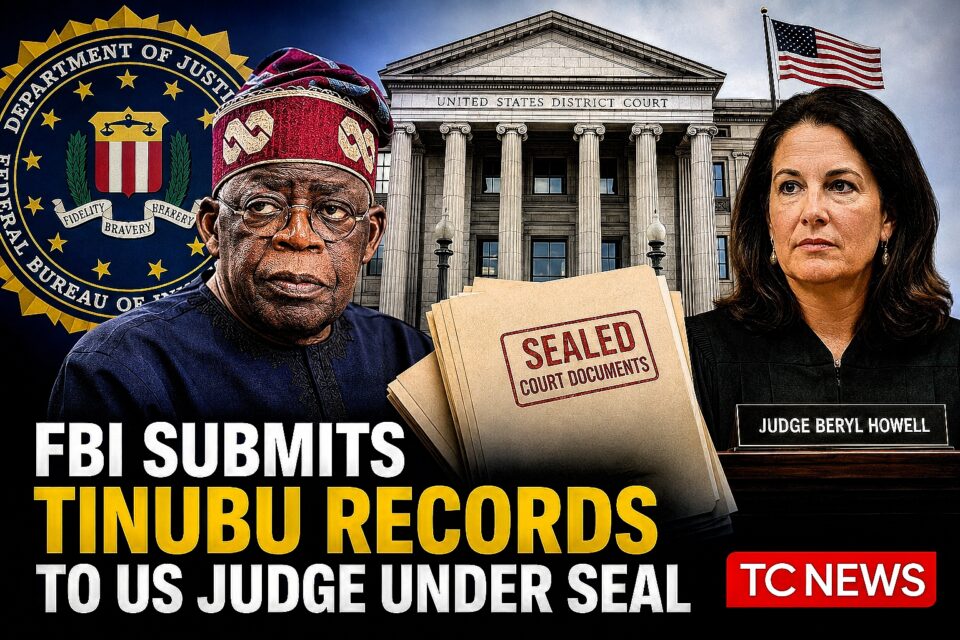
The FBI hand-delivered the materials to U.S. District Judge Beryl Howell of the U.S. District Court for the District of Columbia on Friday, August 28, 2026, as part of an ongoing Freedom of Information Act (FOIA) lawsuit brought by American transparency activist Aaron Greenspan.
Court filings indicate that the FBI submitted the records and accompanying declarations under seal, ex parte and in camera, meaning Judge Howell will review the material privately rather than having it immediately made available to Greenspan or the public.
The development marks another major stage in the long-running legal dispute over access to U.S. government records concerning Tinubu and historical investigations dating back to the 1980s and 1990s.
FBI Records Remain Hidden From Public View
Although headlines surrounding the case have described the material as Tinubu’s “criminal records,” the legal proceedings are more precisely about government investigative records and whether they should be disclosed under U.S. FOIA law.
Greenspan filed FOIA requests seeking records held by U.S. agencies, including the FBI. One of the requests sought the FBI’s file relating to Tinubu, while another sought FBI interview records connected to an investigation from 1992 and 1993.
The FBI has resisted releasing some of the material, citing statutory exemptions relating to privacy, confidential sources, investigative techniques and physical safety.
In an earlier filing, the bureau argued that publicly explaining the full basis for withholding certain information could expose sensitive law-enforcement methods or potentially endanger individuals.
That position prompted the FBI to seek permission from Judge Howell to explain its reasons privately.
What ‘Ex Parte’ and ‘In Camera’ Mean
The legal terms used in the case are important.
An ex parte, in camera submission allows a party to provide sensitive information directly to the judge without making the material available to the opposing party or the general public.
In this case, the FBI’s confidential declarations were submitted to Judge Howell for private consideration. Reports based on the court filings say the submission complied with a court order issued earlier in August.
Therefore, the development should not be interpreted as the public release of Tinubu’s FBI records.
Instead, the judge will have to determine what portions, if any, can ultimately be disclosed.
Tinubu Also Challenges Public Release
The FBI’s submission comes as President Tinubu’s legal team separately challenges efforts to make the records public.
According to court documents reported by Anadolu Agency and Channels Television, Tinubu’s lawyers have asked the U.S. court to prevent the release of records held by the FBI, Department of Justice and Drug Enforcement Administration relating to historical investigations involving him.
His lawyers argue that the requested materials should remain redacted or withheld under applicable privacy and law-enforcement protections.
The legal dispute therefore involves competing interests: Greenspan’s demand for access to government records under FOIA, the government’s arguments for protecting sensitive investigative information, and Tinubu’s privacy interests.
The Background to the Tinubu Records Dispute
The controversy centres on events involving Tinubu in the United States during the early 1990s.
The issue has previously attracted public attention because of a 1993 civil forfeiture proceeding in the United States involving approximately $460,000.
However, it is important to distinguish the historical forfeiture proceeding from a criminal conviction.
The current FOIA case is not a criminal trial against Tinubu. Rather, it concerns whether records held by U.S. government agencies should be released and whether exemptions under American freedom-of-information law justify withholding portions of those records.
A U.S. court previously released documents relating to the historical case, but the latest litigation concerns additional records that Greenspan says should be disclosed.
Why the FBI Wants Some Records Kept Secret
The FBI has cited several FOIA exemptions in defending its decision to withhold certain information.
Among the concerns raised by the bureau are the protection of confidential sources, law-enforcement investigative techniques and the safety of individuals who could potentially be identified through the records.
In a recent filing, the FBI reportedly warned that releasing certain information could expose investigative techniques and potentially place individuals at risk.
The agency has therefore asked the court to consider some of its arguments privately instead of requiring the details to appear in a public filing.
That request is significant because it means Judge Howell will have access to information that neither the public nor Greenspan can currently examine.
What Happens Next?
The immediate question is whether Judge Howell will eventually order the release of some or all of the records.
The judge could accept the FBI’s arguments and allow the disputed information to remain withheld. She could also determine that some materials should be released, potentially with redactions to protect legally exempt information.
For now, however, there has been no public release of the FBI records submitted on August 28.
That distinction is crucial as claims circulate online suggesting that the FBI has already released Tinubu’s alleged criminal records.
The available reporting indicates that the records were submitted to the court under seal, not published for public inspection.
Why This Matters
The case has significant political and transparency implications, particularly as Nigeria moves closer to the 2027 general elections.
For Greenspan, the lawsuit represents an effort to obtain government records through the U.S. FOIA system.
For the FBI, the dispute tests how much information concerning old investigations can be released without compromising privacy, confidential sources, investigative methods or safety.
For Tinubu, the case has the potential to reignite scrutiny of long-running questions surrounding his history in the United States.
Yet the legal process must be allowed to determine what the records actually contain and which portions, if any, can legally become public.
Until that happens, claims that the FBI records establish criminal wrongdoing should be treated with caution.
Frequently Asked Questions
Has the FBI released Tinubu’s records to the public?
No. The latest reports indicate that the FBI submitted the records to Judge Howell under seal for private judicial review.
What is Aaron Greenspan seeking?
Greenspan is seeking access to U.S. government records relating to historical investigations involving Tinubu through FOIA litigation.
What does ‘in camera’ mean?
It means the judge reviews material privately rather than as part of the public court record.
Why is the FBI withholding some records?
The FBI has cited FOIA exemptions involving privacy, confidential sources, investigative techniques and safety concerns.
Does the case mean Tinubu has been convicted of a crime in the United States?
No. The current proceeding is a FOIA dispute over access to government records. It should not be described as a criminal conviction.
Conclusion
The submission of Tinubu-related records by the FBI to Judge Beryl Howell represents a significant development in the continuing FOIA battle, but it is not the public release of the documents.
For now, the records remain under seal while the court considers the government’s arguments for withholding them and the demands for greater disclosure.
The eventual ruling could determine whether additional records become public, remain redacted or stay completely confidential.
As the legal battle continues, the contents of the sealed materials remain unknown to the public.
Drop your thoughts in the comments. 👇
#Tinubu #FBI #AaronGreenspan #NigeriaPolitics #USCourt #FOIA #BolaTinubu #BreakingNews #TCNEWS
