

By DAYO ADESULU
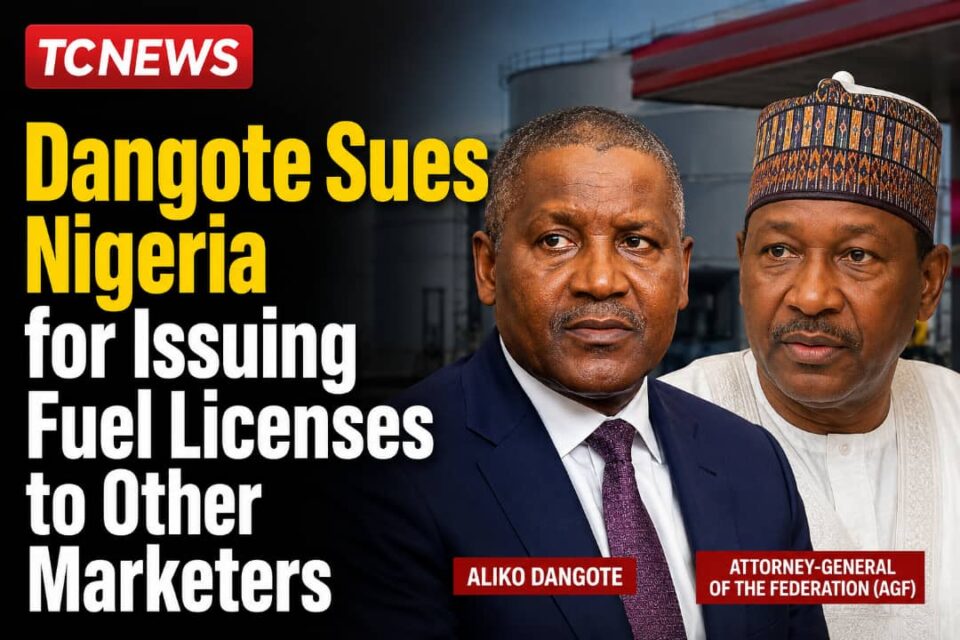
Fresh controversy has erupted in Nigeria’s oil and gas sector as Dangote Petroleum Refinery filed a new lawsuit challenging the continued issuance of petrol import licences to oil marketers and the Nigerian National Petroleum Company Limited.
The legal action has reignited debate over whether Nigeria should still depend on imported fuel despite the operation of Africa’s largest refinery.
According to court documents, the refinery approached the Federal High Court in Lagos to contest approvals granted by the Nigerian Midstream and Downstream Petroleum Regulatory Authority (NMDPRA), arguing that the licences violate existing legal and regulatory provisions.
Dangote Refinery Challenges Fuel Import Approvals
The refinery reportedly sued Nigeria’s Attorney-General, seeking an order to nullify recently issued or renewed permits allowing marketers to import petroleum products into the country.
In its filing, the refinery argued that the approvals contradict an earlier court directive instructing all parties to maintain the status quo pending the determination of the matter.
The latest move comes months after the company quietly withdrew a similar case it filed in 2025 against the Nigerian National Petroleum Company Limited and several fuel importers.
Industry observers believe the renewed legal battle could reshape discussions around fuel supply, local refining capacity, and competition in Nigeria’s downstream petroleum sector.
Marketers Defend Continued Fuel Importation
Oil marketers and regulators have continued to defend the importation of petrol, insisting that local refining output remains insufficient to meet nationwide demand.
They argued that import licences remain necessary to prevent fuel scarcity and stabilise distribution across the country.
However, Dangote Refinery maintained that Nigeria’s petroleum laws only permit fuel importation when domestic production cannot satisfy market demand.
The company further claimed that the persistent issuance of licences undermines the refinery’s operations and discourages local investment in refining infrastructure.
The dispute reflects growing tension between local refiners and fuel importers over the future direction of Nigeria’s petroleum market.
Nigeria’s Dependence On Imported Petrol
For decades, Nigeria relied heavily on imported refined petroleum products due to the poor performance of government-owned refineries.
The development fueled high import bills and repeated fuel supply crises across the country.
The $20 billion Dangote Refinery, designed to refine 650,000 barrels of crude oil daily, was expected to significantly reduce Nigeria’s dependence on imported fuel after commencing operations.
Despite the refinery’s production rollout, fuel importation has continued, with stakeholders arguing that supply gaps still exist as the facility gradually ramps up operations.
Energy analysts said the court action may intensify pressure on regulators to clarify the implementation of Nigeria’s petroleum laws concerning local refining and importation.
Refinery Raises Fresh Concerns Over Crude Supply
The lawsuit comes amid lingering disagreements between the refinery and upstream oil producers over crude oil supply obligations.
Earlier, Dangote Refinery accused Nigerian crude producers of failing to supply adequate crude oil to the facility as stipulated under the Petroleum Industry Act (PIA).
The company said the situation forced it to depend heavily on international traders, who reportedly charge additional premiums that increase operational costs.
According to the refinery’s management, sourcing crude from foreign traders has made refining more expensive at a time when the company is trying to maintain stable fuel supply within Nigeria.
The refinery also stated that Nigerian crude oil prices currently trade above global benchmark rates, worsening procurement costs.
Oil Sector Tensions Deepen
The latest lawsuit signals another major confrontation in Nigeria’s oil industry as stakeholders continue to disagree over market liberalisation, fuel supply control, and refining dominance.
Economic experts warned that prolonged disputes between regulators, marketers, and refiners could affect investor confidence in Nigeria’s energy sector.
At the same time, supporters of local refining insist that Nigeria must gradually phase out fuel importation to protect domestic investments and strengthen energy security.
Others, however, argued that competition from imports remains necessary to prevent monopolies and ensure consumers enjoy stable fuel availability and competitive pricing.
As the court prepares to hear the matter, many Nigerians are watching closely to see whether the legal battle will influence the future of fuel importation and refining in Africa’s largest oil-producing nation.
#DangoteRefinery #NNPCL #FuelImportation #OilAndGas #NigeriaEconomy #Petrol #NMDPRA #EnergySector
