

By DAYO ADESULU
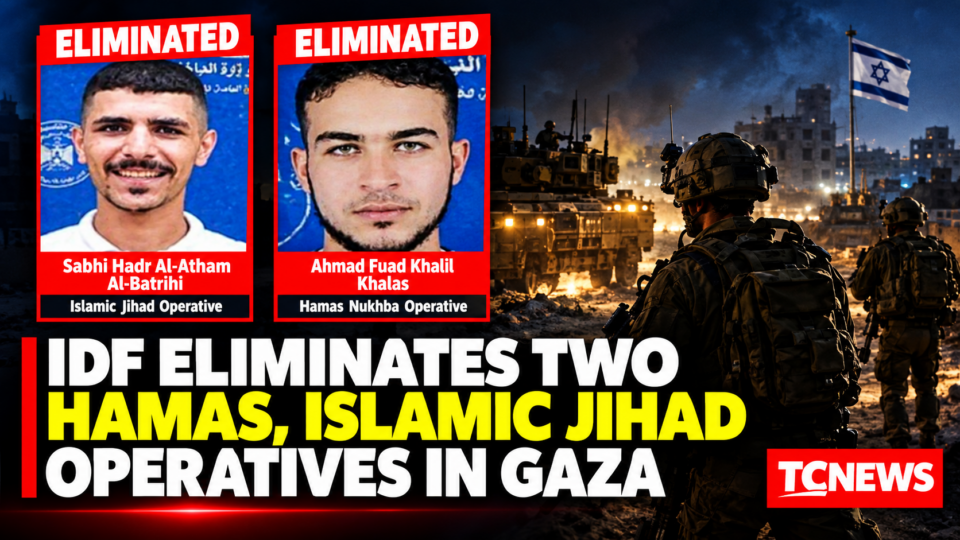
The Israel Defense Forces (IDF) says it has eliminated two members of Hamas and Palestinian Islamic Jihad in separate strikes in the Gaza Strip, accusing the operatives of planting explosive devices and advancing attacks against Israeli troops and civilians in violation of the ceasefire.
According to the IDF, the operations were carried out as part of ongoing efforts by Israeli forces to remove what it described as immediate threats to troops operating under the Southern Command.
Islamic Jihad Operative Eliminated in Al-Shati
The IDF said one of the operatives, identified as Sabhi Hadr Al-Atham Al-Batrihi, was struck on Sunday in the Al-Shati area of the Gaza Strip.
The military identified Al-Batrihi as an operative affiliated with Palestinian Islamic Jihad and accused him of participating in the planting of explosive devices targeting IDF troops operating in Gaza.
The IDF said his activities constituted a direct threat to Israeli forces and formed part of what it described as continuing militant operations despite the ceasefire.
The military stated that the strike was conducted to remove the threat posed by the operative.
Hamas Nukhba Operative Also Targeted
In a separate operation conducted the previous week, Israeli forces struck and eliminated Ahmad Fuad Khalil Khalas, whom the IDF identified as a Nukhba operative in Hamas’ military wing.
According to the Israeli military, Khalas participated in planting explosive devices and carrying out hostile activities against IDF troops in the Gaza Strip.
The IDF said intelligence and operational assessments indicated that both men had recently been involved in advancing attacks against Israeli forces and Israeli civilians.
The military described the activities as a systematic violation of the ceasefire, saying the strikes were intended to prevent further attacks.
IDF Cites Measures to Protect Civilians
The IDF said it took measures before carrying out the strikes to reduce the potential risk to civilians in the areas where the operatives were located.
According to the military, those measures included the deployment of precise munitions and aerial surveillance to improve targeting accuracy and assess the surrounding environment.
The IDF has repeatedly said its operations in Gaza are focused on militant targets and that it takes steps to limit civilian harm when conducting strikes.
However, claims concerning military operations and casualties in Gaza are often disputed by opposing parties, and independent verification of individual battlefield claims can be difficult amid continuing conflict.
IDF Says Southern Command Remains Deployed
The Israeli military said its forces under the Southern Command remain deployed in Gaza in accordance with the existing agreement.
The IDF added that its troops would continue operating against what it considers threats to Israeli forces and civilians.
The latest strikes underscore the fragile security situation surrounding the ceasefire, with Israel maintaining military positions and continuing to monitor militant activity while accusing Hamas and Islamic Jihad operatives of preparing or carrying out attacks.
For Israel, the stated objective is to prevent armed groups from rebuilding their operational capabilities and threatening Israeli troops or communities.
For Palestinians, however, continued Israeli military operations remain a major source of concern, particularly because of the potential consequences for civilians living in densely populated areas of the Gaza Strip.
Why This Matters
The reported elimination of the two operatives highlights the continuing tension surrounding the Gaza ceasefire.
Even where a ceasefire agreement is in place, the presence of armed groups, explosive devices and military deployments creates the possibility of renewed clashes.
The IDF’s statement also indicates that Israel intends to maintain a proactive security posture in Gaza, arguing that ceasefire arrangements do not prevent it from acting against what it identifies as immediate threats.
At the same time, continued military action raises questions about civilian safety and the durability of the ceasefire. Any escalation could complicate broader efforts aimed at maintaining calm and preventing a return to sustained hostilities.
Frequently Asked Questions
Who were the two operatives identified by the IDF?
The IDF identified them as Sabhi Hadr Al-Atham Al-Batrihi, whom it described as an Islamic Jihad operative, and Ahmad Fuad Khalil Khalas, whom it identified as a Hamas Nukhba operative.
Where was the first strike conducted?
The IDF said Al-Batrihi was struck in the Al-Shati area of the Gaza Strip on Sunday.
What did the IDF accuse the two men of doing?
The military accused both operatives of participating in activities targeting IDF troops, including planting explosive devices. It also said they had recently advanced attacks against Israeli troops and civilians.
Did the IDF say civilians were considered before the strikes?
Yes. The military said it used precise munitions and aerial surveillance as part of measures intended to mitigate potential harm to civilians.
Is the IDF’s account independently verified?
The information comes from the Israeli military’s official statement. Battlefield claims in Gaza can be difficult to independently verify, particularly while hostilities and restrictions on access continue.
Conclusion
The IDF’s latest announcement points to the continuing security challenges surrounding the Gaza ceasefire. Israeli forces say they eliminated two Hamas and Islamic Jihad operatives accused of preparing attacks and planting explosives against troops.
While the military maintains that the strikes were necessary to remove threats and that precautions were taken to protect civilians, the developments also demonstrate how fragile the situation remains.
As IDF troops continue to operate under the Southern Command, further incidents could test the resilience of the ceasefire and shape the next phase of the conflict in Gaza.
#IDF #Gaza #Hamas #IslamicJihad #Israel #GazaCeasefire #MiddleEast #TCNEWS
