

By Dayo Adesulu
Israeli Prime Minister Benjamin Netanyahu’s reported conditions for forming a national unity government with opposition leader Gadi Eisenkot have triggered fresh political controversy, exposing deep divisions over Israel’s security strategy, judicial reforms, the Palestinian question and the future of the country’s leadership.
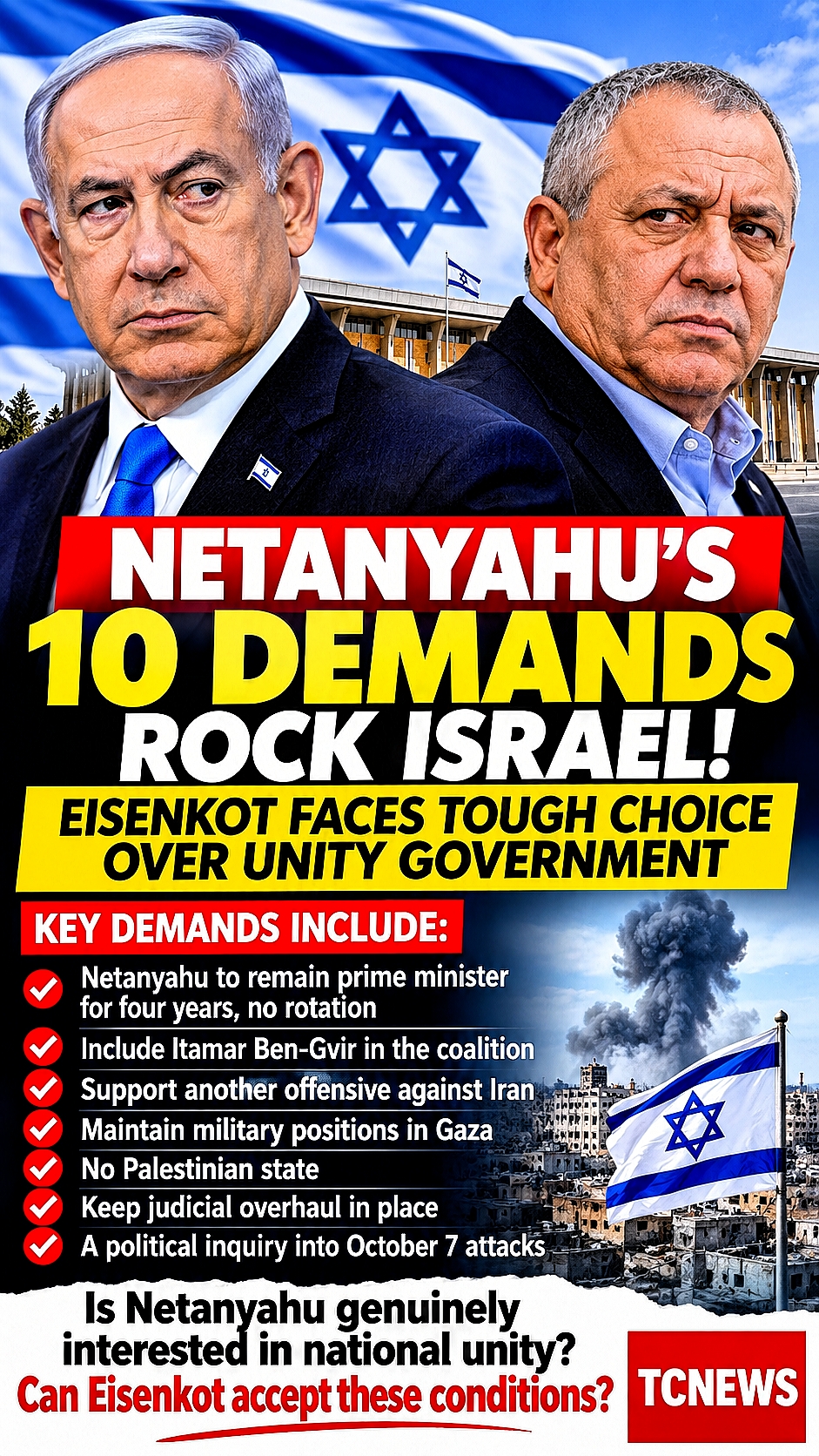
The demands, reportedly presented by Netanyahu’s Likud party during negotiations over a possible unity arrangement, include keeping Netanyahu as prime minister for the full four-year term, retaining far-right politician Itamar Ben-Gvir in the proposed coalition and maintaining Israel’s hardline security positions on Iran and Gaza.
The reported conditions have raised serious questions about whether Netanyahu and Eisenkot can overcome their political differences to establish a broad-based government at a time when Israel continues to grapple with major security and political challenges.
According to reports published by Israeli media outlets, including Channel 12, Ynet News and The Times of Israel on November 20, 2026, Likud outlined a series of conditions that could significantly influence the structure and policy direction of any proposed unity administration.
However, Likud has disputed aspects of the reports, making it important to distinguish between the reported negotiating positions and formally agreed government policies.
### Netanyahu Wants Full Four-Year Leadership Term
One of the most contentious demands attributed to Likud is Netanyahu’s insistence on remaining prime minister throughout the proposed government’s four-year tenure.
The position effectively rules out a rotation arrangement under which Eisenkot could take over the premiership at an agreed point during the administration.
Such an arrangement could become a major obstacle because leadership and the distribution of political power would remain central to negotiations between the two camps.
Eisenkot, a former Israel Defense Forces chief of staff, has emerged as an important opposition figure, with his political bloc seeking a different direction for the country’s leadership.
Consequently, Netanyahu’s reported insistence on retaining the premiership could make negotiations considerably more difficult.
### Likud Wants Ben-Gvir Included in the Coalition
Another controversial condition involves the inclusion of National Security Minister Itamar Ben-Gvir and his Otzma Yehudit party in the proposed unity government.
Ben-Gvir is one of Israel’s most prominent far-right politicians. His political positions, particularly on Palestinian issues and national security, have frequently generated controversy both within Israel and internationally.
His inclusion could create serious difficulties for Eisenkot, whose political bloc would have to consider whether it could work alongside a politician associated with positions significantly different from its own.
For Netanyahu, however, retaining Ben-Gvir’s political support could help preserve the existing right-wing coalition structure.
The demand therefore highlights a fundamental disagreement over the political character of any proposed unity government.
### Iran and Gaza Remain Major Points of Disagreement
The reported conditions also indicate that Netanyahu’s Likud wants a future coalition to support another military offensive against Iran.
This position could become one of the most consequential aspects of the negotiations, particularly given the continuing security tensions surrounding Iran and Israel.
A commitment to another offensive would require any incoming government to adopt a strong military posture towards Tehran.
However, Eisenkot and his political allies would have to consider the military, diplomatic and economic implications of such a commitment before accepting it.
The Gaza conflict presents another major challenge.
According to the reported demands, Likud wants Israel to maintain its military positions in Gaza until the Hamas threat has been eliminated.
This would preserve a hardline security approach towards the Palestinian territory and could complicate efforts to establish a different post-war political and security arrangement.
The disagreement could also affect Israel’s international relations, particularly its engagement with countries advocating a political settlement to the conflict.
### Judicial Reforms and Palestinian Statehood Complicate Negotiations
Beyond military and security questions, the reported demands extend to Israel’s domestic political and constitutional debates.
Likud reportedly wants existing judicial overhaul legislation maintained until political consensus emerges.
The judicial overhaul remains one of Israel’s most divisive political issues. Its supporters argue that changes are necessary to rebalance powers between elected institutions and the judiciary.
However, opponents have warned that the reforms could weaken judicial independence and undermine democratic safeguards.
Eisenkot’s position on the matter could therefore become an important factor in determining whether the two political camps can reach an agreement.
The Palestinian question presents another major disagreement.
Likud reportedly wants the proposed coalition to reject the establishment of a Palestinian state.
Such a position would reinforce Netanyahu’s longstanding opposition to Palestinian statehood and could further complicate Israel’s diplomatic relationships with international partners seeking a two-state solution.
### October 7 Investigation Becomes Another Flashpoint
Perhaps one of the most politically sensitive demands concerns the investigation into the October 7, 2023, Hamas-led attacks on Israel.
The reported Likud position favours a politically appointed inquiry rather than a state commission of inquiry.
The distinction is significant because the October 7 attacks exposed serious intelligence and security failures and generated widespread demands for accountability.
A state commission of inquiry is generally regarded as an independent investigative mechanism with significant legal authority.
By contrast, a politically appointed inquiry could attract criticism over its independence, composition and ability to investigate decisions made by senior government officials.
The question of who investigates the October 7 failures has remained a major source of political tension in Israel.
For Eisenkot and other opposition figures, the credibility of any investigation could become an important test of whether a unity government would genuinely pursue accountability.
### Additional Conditions Reveal the Depth of the Political Divide
The reported 10-point list also includes provisions concerning military service exemptions for ultra-Orthodox Jews, the treatment of Hamas Nukhba fighters detained by Israel and recognition of Israel as the nation-state of the Jewish people.
These issues demonstrate that the negotiations extend beyond the allocation of government positions.
They involve fundamental disagreements about Israel’s national identity, military obligations, democratic institutions and long-term security policy.
The ultra-Orthodox military service question, in particular, has generated significant public debate, with many Israelis demanding equal military obligations across religious and social groups.
Consequently, incorporating such conditions into a unity agreement could expose the proposed administration to further political resistance.
### Eisenkot Considers Alternative Government as Talks Face Uncertainty
Despite the reported disagreements, Eisenkot has not completely abandoned the possibility of reaching an agreement with Likud.
However, the opposition leader is also considering alternative arrangements if negotiations fail.
In a statement published on November 20, Eisenkot indicated that he would move towards establishing a national emergency government if his efforts to form a broader coalition did not succeed.
He identified three possible political routes: a unity government with Likud, an arrangement involving ultra-Orthodox parties, and an emergency minority government that could depend on support from Arab-led parties outside the coalition. The Times of Israel +1
The minority government option, however, faces its own obstacles.
Avigdor Liberman, leader of Yisrael Beytenu, has warned that his party would oppose a government relying on the support of Arab parties. His position could make it difficult for Eisenkot to secure the parliamentary numbers required to form an administration. The Times of Israel +1
Meanwhile, Netanyahu has intensified his public appeal for a unity government, arguing that Israel faces a critical security moment and should not depend on Arab-led parties to establish a government. The Jerusalem Post
The negotiating teams are expected to resume discussions on Sunday, November 22, although the possibility of a breakthrough remains uncertain.
### Likud Pushes Back Against Parts of the Report
Although the reported 10-point proposal has attracted considerable attention, Likud has challenged important aspects of the account.
In its response, the party specifically disputed three claims relating to an investigative commission, judicial reform and military conscription legislation.
However, it did not directly address every condition attributed to it in the Channel 12 report. The Times of Israel
This distinction matters because the reported demands represent Likud’s negotiating position, not a completed agreement between the political camps.
Nevertheless, the disagreement reveals the extent of the political divide confronting both sides.
### Why This Matters
The negotiations could shape Israel’s political direction, military strategy and relationship with the international community.
If Netanyahu secures a unity government on the reported terms, he could retain the premiership for another four years while preserving significant elements of his existing political and security agenda.
However, if Eisenkot rejects the conditions, Israel could face another difficult round of coalition negotiations, with the possibility of a minority administration or further political instability.
The disagreement also raises broader questions about accountability for the October 7 attacks, the independence of judicial institutions and the future of Israeli-Palestinian relations.
Ultimately, the outcome will determine whether Israel moves towards a broader political compromise or continues along the sharply divided path that has characterised its recent politics.
### Frequently Asked Questions
1\. What are Netanyahu’s reported demands for a unity government?
The reported 10 demands include a full four-year premiership for Netanyahu, inclusion of Ben-Gvir, support for another offensive against Iran, maintaining judicial overhaul legislation, a political inquiry into October 7, military service legislation, maintaining Gaza positions, opposition to Palestinian statehood and recognition of Israel as the Jewish nation’s state.
2\. Who is Gadi Eisenkot?
Gadi Eisenkot is an Israeli opposition politician and former Israel Defense Forces chief of staff. He leads the Yashar political party and is involved in efforts to form Israel’s next government.
3\. Does Netanyahu want to share power with Eisenkot?
According to the reported Likud proposal, Netanyahu wants to serve the entire four-year term without a rotation arrangement.
4\. What happens if unity negotiations fail?
Eisenkot has indicated that he could pursue an emergency minority government if efforts to establish a broader coalition fail.
5\. Has Likud officially confirmed all 10 demands?
No. Likud has disputed aspects of the reporting, particularly claims concerning the October 7 inquiry, judicial reforms and military conscription legislation.
### Conclusion
Netanyahu’s reported 10 demands have exposed the difficult choices confronting Israel’s political leadership as Eisenkot attempts to form a new government.
While Netanyahu is pushing for a unity administration that preserves his leadership and existing political alliances, Eisenkot must decide whether the price of such an agreement is too high.
With disagreements over Iran, Gaza, judicial reforms, Palestinian statehood and accountability for October 7, the negotiations could become a defining moment in Israeli politics.
For now, the question is whether national unity can overcome the political ambitions and ideological differences separating the two camps.
#IsraelPolitics #Netanyahu #Eisenkot #TheCheerNews
