

By DAYO ADESULU
A professor at Babcock University has called for urgent and coordinated action across African nations to address the continent’s rising population growth and worsening nutritional challenges, warning that poor dietary outcomes could undermine Africa’s future development.
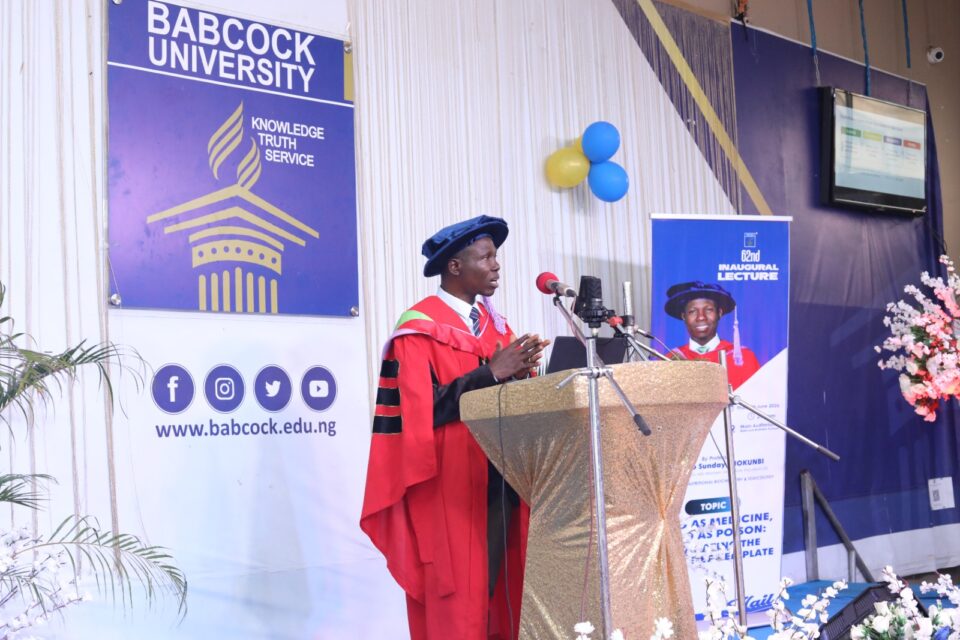
The call was made by Prof. Olutayo Sunday Sokunbi during the university’s 62nd inaugural lecture titled “Food as Medicine, Food as Poison: Navigating the Double-Edged Plate.” The lecture focused on Africa’s struggle with poverty, rapid population growth, and increasing cases of childhood malnutrition, including stunting, wasting, and micronutrient deficiencies.
The event attracted prominent dignitaries, including the First Lady of Ogun State, Bamidele Abiodun, alongside academics, health professionals, and policymakers.
Call for a “First 1000 Days” Nutrition Strategy
Prof. Sokunbi emphasized the need for a continental “First 1000 Days” nutrition strategy, stressing that early childhood nutrition remains critical to human development and long-term health outcomes.
He proposed a multi-sectoral approach that includes:
Standardisation of complementary food formulations using locally sourced ingredients
Establishment of breast milk banking systems across Africa with proper safety and storage protocols
Development and commercialisation of lactogenic agents derived from Africa’s biodiversity
Harmonised maternity and paternity leave policies across African countries
Strengthening of community-based nutrition programmes to reach rural and vulnerable populations
According to him, Africa’s demographic trends can either become a burden or a major advantage, depending on how well nutrition challenges are addressed.
“Food can be both medicine and poison. The choices we make in nutrition will determine our health status and whether Africa’s demographic advantage becomes a blessing or a burden,” he said.
Call for Policy and Research Investment
The don also urged Nigerian authorities and other African governments to increase investment in research, medical education, and the development of herbal and plant-based medicinal products.
He advocated stronger collaboration between government agencies, pharmaceutical scientists, and traditional medicine practitioners to unlock the health potential of Africa’s biodiversity.
According to him, targeted policies and funding would help stimulate local industries, promote innovation, and reduce dependence on imported medical solutions.
“It is high time to train our physicians to appreciate the huge blessing of medicinal plants available to us as a nation,” he added.
Integrating Traditional and Modern Medicine
Prof. Sokunbi further stressed the need to integrate traditional medicine into modern healthcare systems and medical training, arguing that Africa’s rich plant resources remain underutilised in scientific research and product development.
He maintained that such integration, combined with strong government support, could transform Africa’s demographic pressure into a “demographic dividend,” ensuring improved health outcomes for future generations.
A Vision for Africa’s Health Future
The lecture concluded with a strong appeal for unity among African stakeholders to reposition nutrition and healthcare systems. Prof. Sokunbi noted that with coordinated action, Africa could turn its population growth challenges into opportunities for sustainable development and improved public health.
He reaffirmed that food, if properly harnessed, could serve as a powerful tool for healing rather than harm across the continent.
