

By Adebodun Olalekan
Recent educational statistics have triggered growing conversations across the world. Reports showing female candidates outnumbering males in examinations such as the West African Senior School Certificate Examination (WASSCE), alongside increasing female enrollment in universities globally, are often celebrated as signs of progress in gender inclusion. Indeed, the advancement of girls’ education remains one of the major achievements of modern society after decades of discrimination and restricted access to formal learning.
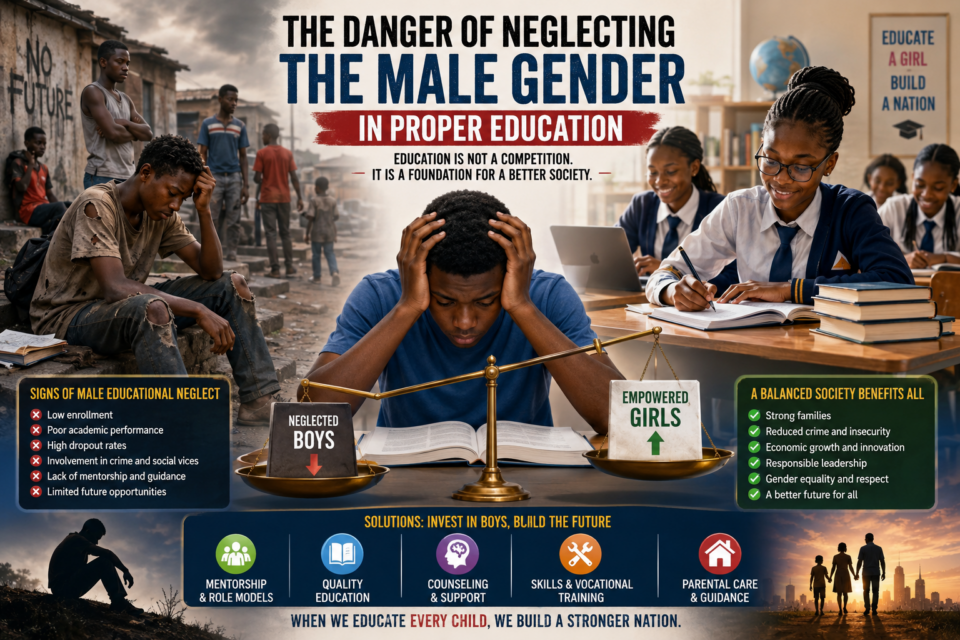
However, beneath these celebrations lies another important issue that deserves serious public attention — the gradual neglect of the male gender in proper education. The concern is not that girls are succeeding academically. Rather, it is that many boys are increasingly falling behind educationally, socially, and psychologically. If societies continue to ignore this trend, the long-term consequences may affect social stability, economic growth, and national development.
Historical Background of Gender and Education
For centuries, education across many societies largely favored men. Women were often excluded from formal education and restricted to domestic responsibilities. In Africa, Europe, Asia, and the Middle East, boys were traditionally prepared for leadership, governance, commerce, and religious duties, while girls were trained mainly for marriage, childcare, and household management.
In pre-colonial African societies, education mostly existed through informal systems such as farming, hunting, apprenticeship, crafts, and oral traditions. Boys usually received training connected to leadership and occupation outside the home, while girls learned domestic and economic skills from older women within their communities.
The arrival of colonialism and missionary education in the nineteenth century further widened the educational gap between boys and girls. Missionary schools across Africa, including Nigeria, prioritized male enrollment because colonial administrators believed boys would later become clerks, teachers, interpreters, and low-level government workers. Female education received far less attention and focused mainly on domestic science, sewing, and childcare.
In Nigeria, early missionary institutions established by organizations such as the Church Missionary Society and Roman Catholic missions were dominated by male students during the nineteenth and early twentieth centuries. Cultural beliefs, early marriage, and religious conservatism discouraged many families from sending girls to school, especially in Northern Nigeria.
Rise of Girl-Child Education Campaigns
By the mid-twentieth century, global attitudes toward female education began changing significantly. Nationalist movements, modernization, industrialization, and feminist advocacy encouraged governments and international organizations to promote women’s rights and educational access.
Following independence across many African nations during the 1950s and 1960s, governments introduced reforms aimed at reducing gender inequality in schools. International organizations such as UNESCO and UNICEF strongly promoted girl-child education as part of broader development goals.
These interventions achieved remarkable success. Female literacy rates improved. More women entered professions previously dominated by men, including law, medicine, engineering, academia, and politics. Today, in several countries, women outperform men academically at secondary and tertiary levels.
Yet, while societies celebrated female educational progress, less attention was given to emerging challenges affecting boys.
Understanding the Causes of Male Educational Decline
Several factors now contribute to the educational struggles facing many boys across Africa and beyond.
Economic Pressure and Child Labor
In many low-income communities, boys are expected to contribute financially to family survival at an early age. Economic hardship pushes many young males into street trading, artisan work, transport businesses, cybercrime, and other informal jobs instead of schooling.
Lack of Positive Male Mentorship
The decline of responsible fatherhood and mentorship has affected many boys negatively. Young males who grow up without guidance often struggle with discipline, ambition, and educational focus.
Harmful Social Definitions of Masculinity
In some communities, academic seriousness among boys is mocked as weakness, while street influence, aggression, and quick wealth receive admiration. Such social pressure discourages many boys from committing themselves fully to education.
Digital Distractions and Social Vices
The rise of social media addiction, online gambling, internet fraud, drug abuse, and celebrity culture has also affected many male students. Several boys now pursue instant financial success rather than long-term educational growth.
Educational Policies Focused Mainly on Girls
Although girl-child education programs remain necessary, many experts now worry that policymakers rarely discuss the specific struggles confronting boys. Scholarships, advocacy campaigns, and mentorship initiatives often focus primarily on girls, leaving struggling boys without adequate institutional support.
Dangers of Ignoring Male Education
Neglecting the educational development of boys carries serious consequences for society.
Rising Crime and Social Instability
Undereducated young men are more vulnerable to criminal activities such as cultism, kidnapping, drug trafficking, cybercrime, violent extremism, and political thuggery. Education remains one of the strongest tools for reducing insecurity and promoting civic responsibility.
Weakening Family Structures
Educated men often play vital roles as responsible fathers, husbands, and community leaders. Poor male educational development may contribute to rising unemployment, family instability, and social frustration.
Economic Consequences
No nation can maximize productivity when a large portion of its male population lacks proper education and employable skills. Declining male participation in higher education may eventually create shortages in technical and scientific sectors.
Psychological and Identity Crisis
Many boys who feel academically disconnected may develop inferiority complexes, depression, or antisocial behavior. Society frequently expects men to provide leadership and economic stability while failing to equip many of them educationally for such responsibilities.
Gender Imbalance in National Development
True national development depends on cooperation between men and women, not competition. When one gender advances educationally while the other declines, social imbalance emerges.
Need for a Balanced Educational Approach
Addressing male educational decline does not mean reducing opportunities for girls. Instead, societies must adopt balanced educational policies that support both genders equally.
Governments, schools, families, and religious institutions should intentionally re-engage boys through:
mentorship programs for male students;
technical and vocational training;
campaigns promoting responsible masculinity;
counseling and psychological support;
scholarships for disadvantaged boys;
stronger parental supervision;
stricter control of youth-related social vices.
Teachers must also recognize that boys sometimes learn differently from girls and may require alternative teaching approaches, particularly during early childhood and adolescence.
Conclusion
The advancement of women in education remains one of the great successes of modern society. Nevertheless, the growing decline in male educational participation should serve as a warning sign rather than a silent crisis.
A society cannot afford an educational system where one gender consistently rises while the other steadily falls behind. Sustainable national development depends on raising educated, disciplined, and responsible men alongside educated, empowered, and successful women.
Ultimately, education should never become a competition between genders. The true goal of education is collective human development — building societies where every child, regardless of gender, has equal opportunity to grow intellectually, morally, socially, and economically.
